
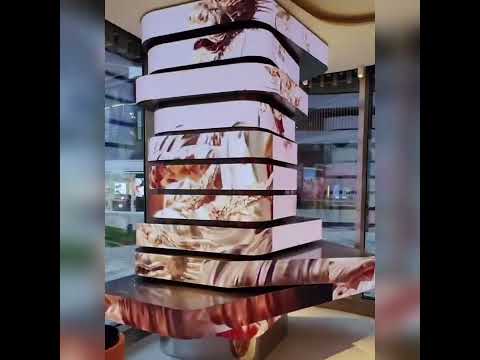
In today’s commercial spaces, a large rectangular LED screen is no longer a rarity. They can be seen everywhere—in shopping malls, stores, clubs, and showrooms.
Screens are getting bigger and bigger, but the number of people who “forget them after seeing them” is also increasing.
When everyone has a large screen, the real question brands need to consider becomes: “Why should my screen be memorable?”
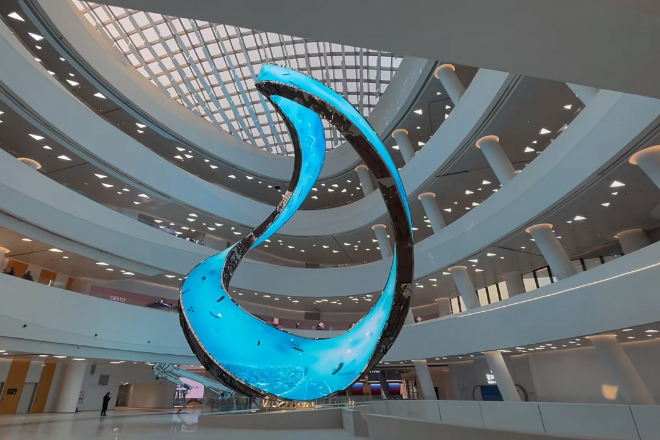
Rather than simply piling on size, more and more brands are experimenting with creative shapes such as curved, circular, wave-shaped.
And even customized logos, making the شاشة ليد itself an integral part of the space and a visual label for the brand.
For example, two stores on the same commercial street might both have 10-meter-wide screens.
One store uses a standard rectangular screen that loops advertisements, while the other has its screen shaped like a brand logo, with the image changing along the outline.
Passersby might not remember the advertisements from either store, but they’re likely to remember: “That store has a very unique screen.”
Ultimately, the competition is no longer just about “who has the bigger screen,” but “whose screen is easier to remember.”
So the question is: if two spaces have similar configurations, will you remember the larger screen first, or the one with the more unique shape?
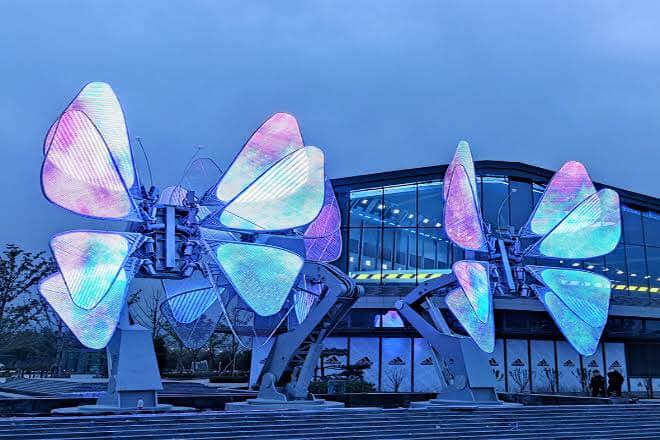
If commercial spaces are filled with square LED screens, it inevitably feels like a “copy and paste.”
Irregularly shaped LED screens offer a different approach: instead of just mounting a screen on a wall, the screen can “grow” with the space.
Circular, curved, and columnar shapes can be integrated with the architectural structure design.
Combined with dynamic content specifically adapted to the screen’s shape, giving the entire space a unique personality.
In this way, the شاشة ليد is not just for displaying advertisements, but can also become a photo backdrop and a brand check-in point.
For example, a trendy club could make its entrance pillars into wraparound LED screens, with the brand logo and dynamic light and shadow flowing along the pillars as members pass by;
A coffee brand could install LED screens on curved walls, allowing images of coffee, the city, and the brand to unfold along the curve.
Customers might not remember the advertising slogan, but they’ll easily remember: “Why is that store’s screen curved?”
Ultimately, irregularly shaped LEDs aren’t simply changing the shape of a “square screen,” but rather adding a unique visual label to a space.
They create a distinctive look that makes people feel special at first glance, and taking a photo can inadvertently promote the brand.
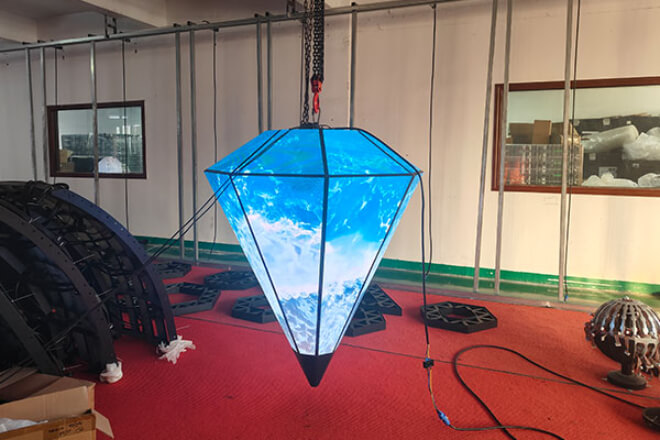
Previously, irregularly shaped شاشات ال اي دي often gave the impression of “rich people wanting to do something different.”
But now more and more commercial spaces are seriously exploring them because ordinary rectangular screens are no longer sufficient to meet some creative design needs.
For example, in clubs, they can be placed at entrances, bar areas, or stage areas, made into curved, circular, or even pillar-shaped screens;
Commercial complexes can place them in atriums, facades, or as art installations, turning ordinary spaces into photo spots.
Brand showrooms can utilize irregularly shaped LED screens to create immersive displays, allowing the visuals surrounding the products to change with the space.
في المتاحف and cultural tourism projects, irregularly shaped LEDs can simulate visual effects such as mountains, starry skies, and historical scenes;
While automotive and technology brand stores are well-suited to using streamlined, futuristic designs to give the space a more technological feel.
For example, a car brand experience store can install curved LED screens behind the vehicles, allowing images of city roads, racetracks, or even futuristic cities to unfold along the curved surface.
The car remains the same, but the background changes, and the entire “atmosphere” of the display space is transformed.
Therefore, irregularly shaped LED screens are evolving from a “special application” into a creative tool for more commercial spaces.
If you were designing a space, where would you place irregularly shaped LED screens? In the prime location at the entrance, or in an unexpected corner?
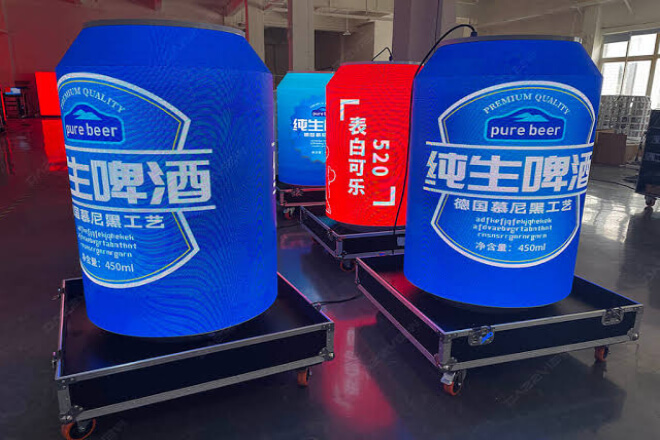
Irregularly shaped LED screens are not necessarily more impressive the more unusual their shape.
Some screens are stunning at first glance, while others seem forced to prove “I can be creative too,” looking awkward no matter how you look at it.
The key is whether it matches the space. The shape should serve the architecture and function, and the content should follow the screen’s shape.
You can’t have a round screen with a rigid, square poster as the image.
في نفس الوقت، سطوع, color, and dynamic effects must be well controlled, especially in rest areas and معرض halls.
There’s no need for the screen to constantly “steal the spotlight.”
For example, a circular LED screen placed at a club entrance allows the logo and light to flow naturally along the circular structure;
However, if it’s just for aesthetics, forcing ordinary advertising content into a circular screen easily makes people wonder, “Why did this screen have to go around in a circle?”
Ultimately, a good irregularly shaped LED screen isn’t necessarily the most complex or extravagant, but rather one that perfectly suits the space.
Creativity isn’t about showing off technology, but about making the space look more complete and interesting.
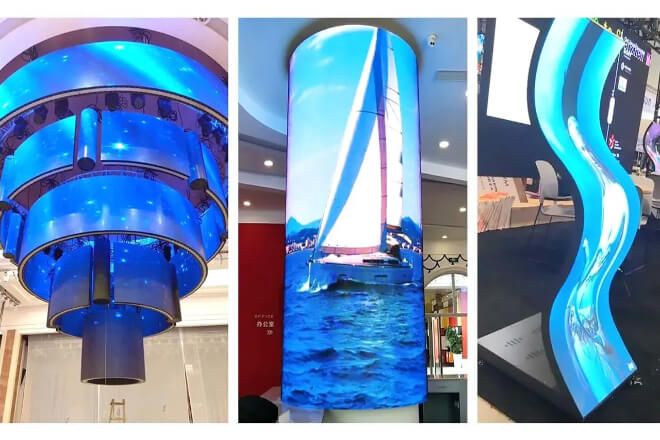
If an irregularly shaped LED screen only serves to “amaze” the audience on the first day, it’s somewhat wasteful.
The true value of an irregularly shaped شاشة ليد lies in its ability to attract attention today and continue to create value for the space years later.
It can be continuously updated with brand promotions, event information, and themed content, and also serve as a backdrop for social media photos.
When members, customers, or tourists share photos, the unique screen shape itself is an easily memorable visual label.
Furthermore, the same screen can switch uses according to different needs: for brand displays, as a stage backdrop for events, as a digital art installation for المعارض, and to showcase collaborating brands in commercial partnerships.
Don’t let a device only have one “skill.”
على سبيل المثال، أ الفندق lobby installed a wave-shaped LED wall, which normally displays brand visuals and natural lighting;
During holidays, it changes to a holiday theme; and for press conferences, it becomes an event backdrop.
The screen’s shape remains the same, but it can continuously “change its identity” according to operational needs.
Therefore, what irregularly shaped LED screens truly change is not “what the screen looks like,” but how the space can be expressed.
Design is responsible for attracting the first glance, while continuous operation allows this creativity to slowly transform into real long-term value.


 English
  Español
  简体中文
简体中文  Français
  日本語
日本語  한국어
한국어  العربية