
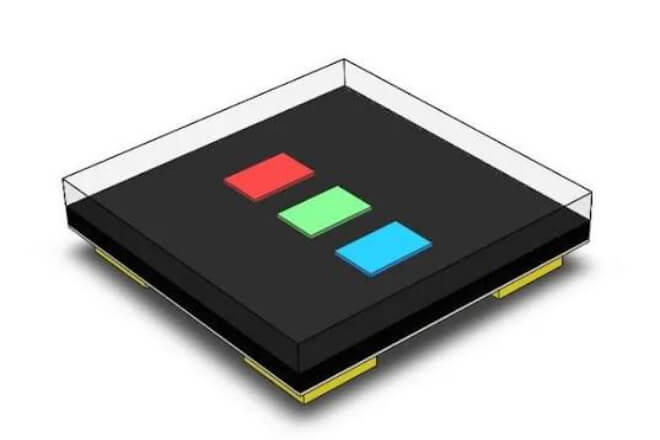
If you’ve been following يعرض الصمام lately, you might have noticed a new name appearing more and more frequently: MIP LED.
What exactly is it? Why are some high-end display projects starting to pay attention to it? Does a newer name necessarily mean better display quality?
Actually, MIP isn’t some mysterious technology. Today, we’ll start with a simple question to see what changes this new packaging technology can bring to LED displays.
Don’t rush into complex technical parameters. We can imagine an عرض الصمام as a picture composed of countless tiny light bulbs.
Each tiny bulb is responsible for displaying a portion of the colors in the image. When these bulbs are arranged densely enough, we see a complete picture.
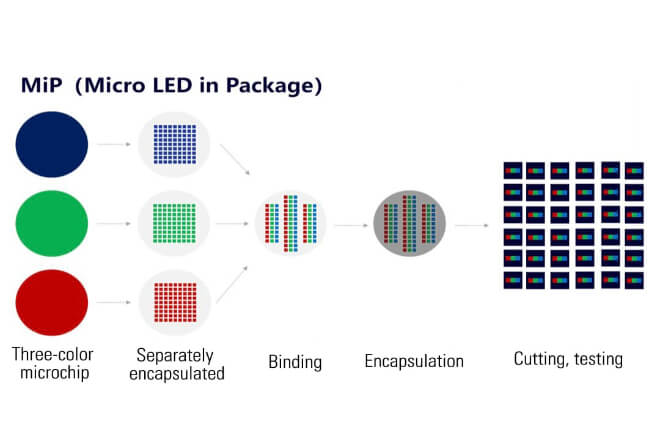
Simply put, MIP LED display technology involves first packaging tiny LED chips into independent micro-devices, then mounting these devices onto the display’s circuit board to ultimately form a complete display image.
MIP is an abbreviation for Micro LED in Package, commonly used to describe the packaging technology route for micro-LED chips.
Its basic process can be divided into several steps:
Step 1: Preparing Micro LED Chips.
First, prepare micro LED chips in three colors: red, green, and blue. These chips are very small and require high processing precision.
Step 2: Individually Packaging the Chips.
This step can be understood as preparing an independent small shell for each micro LED chip, making it a packaged device that can be further installed and tested.
Step 3: Testing and Sorting.
After packaging, the سطوع, color, and other performance characteristics of the devices need to be tested and sorted to ensure that the light-emitting devices on the same screen are as consistent as possible.
Step 4: Installation into the Display Module.
The tested devices are installed on the circuit board, and then, together with the driver chip, control system, and image calibration, the final MIP LED display screen is formed.
So, why is this technology worth paying attention to?
Because as LED displays become increasingly high-definition, the مساحة وحدة الصورة is also constantly shrinking.
In the past, a large LED display screen might have been mainly used for long-distance advertising;
Now, more and more companies want to bring LED displays into conference rooms, معرض halls, and even studios.
As viewers get closer to the screen, their demands for image detail naturally increase.
MIP (Multi-In-Package) LEDs have gained attention precisely because of this market demand.
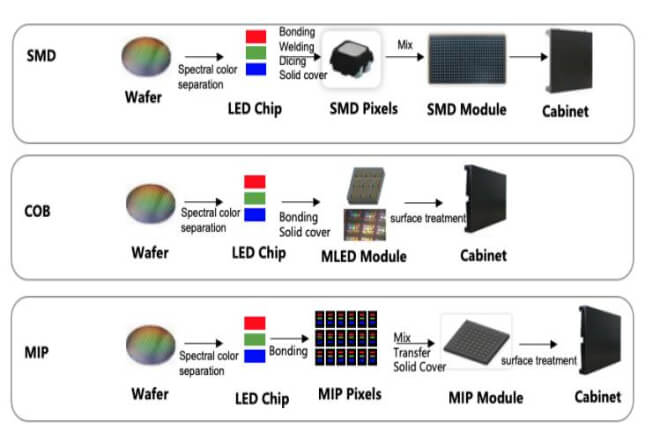
When discussing MIP, two other common technologies must be mentioned: SMD and COB.
If we compare manufacturing an LED display to building a house, then SMD, COB, and MIP are like three different construction methods.
They can all build a house, but the material handling and construction processes differ.
1) إس إم دي:
SMD uses individually packaged LED devices, integrating red, green, and blue light-emitting chips into the packaged device before mounting it onto the display module.
Its advantages include mature technology, a well-established supply chain, and a very wide range of applications.
For example, SMD technology can be seen in مركز تجاري advertising screens, منصة backdrops, outdoor advertising screens, and ordinary indoor LED displays.
However, as pixel pitch continues to shrink, device size and manufacturing precision may become limiting factors for further development.
2) كوب:
COB takes a different approach. Instead of packaging the chips into individual LED beads first, it mounts the bare chips directly onto the circuit board and then performs overall packaging.
It can be understood as follows: SMD first manufactures individual small components and then mounts them onto the board;
COB mounts the chips onto the board first and then encapsulates and protects the entire area.
This method is beneficial for achieving small-pitch displays and can form a relatively complete surface protection layer.
For projects requiring close-range viewing and seeking improved surface protection, COB is a worthwhile solution.
3) MIP:
MIP differs from the previous two.
It first packages the micro-LED chips into individual devices and then performs subsequent assembly.
This method can advance some testing and sorting work to the device stage and provides new options for display products with even smaller pixel pitches.
So, which of the three is better?
There is no absolute answer.

The attention given to MIP is largely related to a trend: people want يعرض الصمام to withstand not only long-distance viewing but also close-up viewing.
Previously, advertising screens were installed on building exteriors, with viewers potentially tens of meters away; the image only needed to be sufficiently eye-catching.
Now the situation is different.
Many companies want to place large LED displays directly in front of conference tables, in the center of exhibition halls, or even as a visual backdrop for the entire space.
In this case, the detail on the image becomes extremely important.

Every new technology has its advantages and challenges.
MIP is no exception.
Advantage 1: Providing a new technological route for ultra-small pixel pitch
As display مساحة وحدة الصورة continues to shrink, traditional packaging methods face increasingly higher manufacturing precision requirements.
MIP, through microchips and individually packaged devices, offers a new option for high-density displays.
This is a key reason for its popularity among projects seeking high-definition displays.
Advantage 2: Facilitating device testing and color management
Imagine a display screen with thousands of light-emitting devices. If some of them are reddish and others bluish, the entire screen could exhibit uneven color.
MIPs (Micro-Instrument Packets) can be tested and sorted at the device stage, helping manufacturers control brightness and color variations.
Of course, the final image uniformity still depends on subsequent module calibration and overall screen debugging.
Advantage 3: Retaining the characteristics of individually packaged devices
Unlike monolithic packaging structures, MIPs use individually packaged devices.
In some product designs, individual devices can be tested and replaced, providing flexibility for repairs.
However, this doesn’t mean all MIP displays can be repaired as easily as ordinary LED chips; it depends on the package size, repair tools, and the manufacturer’s processes.
So, are there any drawbacks to MIPs?
Of course.
First, MIPs have high requirements for microchip manufacturing, packaging, and transfer processes, making product manufacturing quite challenging.
Second, different manufacturers may have different product structures, manufacturing processes, and quality control capabilities, and market maturity needs to be assessed in conjunction with the specific product.
Furthermore, companies need to understand the purchase price, device supply, and subsequent repair costs in advance.
Therefore, while MIP (Megapixel pitch) has development potential, simply labeling a product as MIP does not necessarily guarantee superior performance.

If a company is planning a high-end conference room, command center, or large digital exhibition hall, MIP can be considered.
However, before placing an order, it is recommended to pay attention to the following issues:
1) Don’t just look at the name “MIP”; look at the actual pixel pitch
Companies should first determine the distance of the audience from the screen.
If the screen is installed at the top of a large معرض hall, the audience is usually at a greater distance, so an ultra-small مساحة وحدة الصورة may not be necessary.
If it’s a conference room, where the audience is only a few meters away, then greater attention needs to be paid to the image detail.
2) Always test the actual display effect
Don’t just watch product promotional videos.
It is recommended to have the supplier play the content that the company actually needs to display, such as small-font text, financial tables, product images, and dynamic videos.
Also, observe the screen under different سطوع levels to see if the image is uniform and the colors are natural.
3) Understand repair and spare parts supply in advance
While the independent packaging structure of MIPs sounds convenient, the purchasing manager still needs to clarify:
Is individual component replacement possible?
What tools are needed for repair?
Is recalibration required after repair?
Can the supplier provide spare parts long-term?
Can different batches of products maintain color consistency?
These questions may not appear in the product brochure, but they will affect the user experience for years to come.
4) Don’t Ignore control system and driver technology
The effect of an LED display screen is not solely determined by packaging technology.
Driver chips, control systems, مصادر الطاقة, thermal design, and calibration processes are equally important.
If these components don’t work well together, even advanced packaging technology may not achieve the desired results.
5) Comprehensively compare long-term investment value
Enterprise procurement should not only consider equipment prices but also installation, commissioning, maintenance, spare parts, and future upgrade costs.
If MIPs can significantly improve the display effect required by the project, then increasing the budget may be reasonable.
However, if standard SMD or COB technology already meets the requirements, there’s no need to make unnecessary investments in pursuit of new technologies.


 English
 Español
 简体中文
 Français
 日本語
 한국어
 العربية