

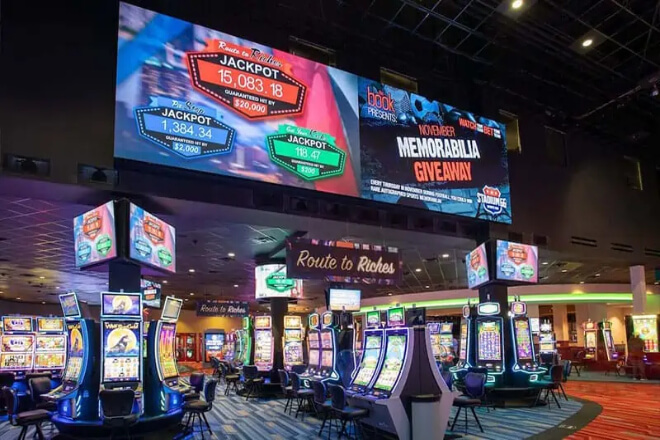
In the special environment of a casino, a “high-سطوع LED display” sounds like standard, but in reality, brightness is often not pleasing, and may even be a bit “overdone.”
Most casino spaces deliberately control overall lighting, using a design with low illumination and ambient lighting.
The goal is clear: to create immersion, allowing players to focus on the game and the experience itself.
In this context, if a screen is as bright as a منصة spotlight, it can easily disrupt this carefully designed atmosphere, even pulling the player out of the game.
Therefore, the issue isn’t “bright enough,” but “is the brightness appropriate?”
The screen needs to be optimized for ambient light—ensuring clear visibility without overshadowing the overall atmosphere of the space.
Too dark, and it’s unreadable; too bright, and it’s glaring. The ideal state is where you can easily see the content without being overwhelmed by it.
From a practical standpoint, excessive brightness can also cause eye strain, especially in environments where you spend a lot of time.
In contrast, a soft yet clear display is more palatable and better suited to the “long-staying space” of a casino.
Simply put, in a casino, an LED display shouldn’t be the brightest spot.
But rather a well-balanced element that creates a specific ambiance—clearly visible when appropriate, and quietly integrated when not stealing the show.
Brightness isn’t about being as high as possible; it’s about finding the “just right” level.
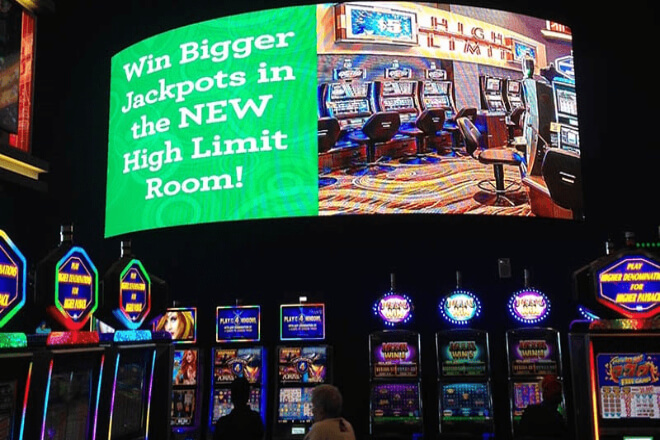
In spaces like casinos, immersion is practically the “core experience,” and a poorly used high-سطوع LED display can actually become a “minor mishap that disrupts the atmosphere.”
Imagine an environment with soft lighting, low intensity, and a slightly mysterious ambiance.
If the screen suddenly becomes very bright, it’s like having a movie light suddenly switched on—the atmosphere instantly dissipates.
Strong light not only easily disrupts the immersive atmosphere but also pulls players out of their “focused state,” negatively impacting the overall experience.
From a behavioral perspective, overly bright screens can also affect how long players stay on screen.
Visually stimulating or glaring images will make people subconsciously want to look away, rather than stop and continue engaging.
Especially in scenarios requiring extended viewing time, comfort is more important than “eye-catching.”
Furthermore, excessive brightness can easily lead to eye strain. Watching a screen in a bright environment for a long time causes eye fatigue.
Which is actually a negative factor, not a positive one, for the player experience.
Therefore, the key is not “how bright it is,” but “whether it’s comfortable and attractive.”
The screen needs to find a balance between attracting attention and maintaining the desired atmosphere, making people willing to look and stay on screen.
Simply put, in a casino environment, an LED display screen is like a “DJ with a great sense of rhythm”—attracting your attention without disrupting your flow—neither overly flashy nor easily ignored, just right for the optimal experience.
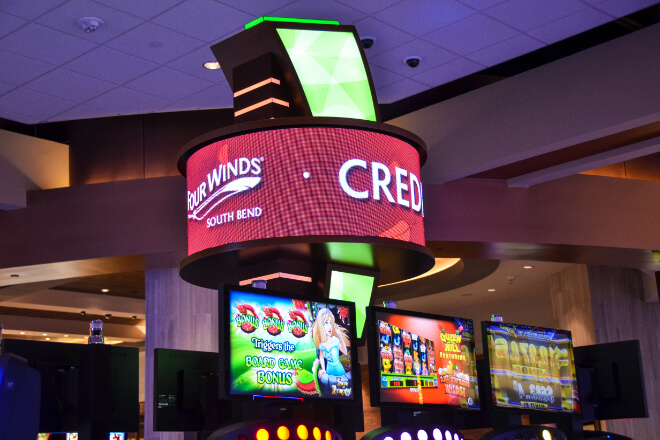
In a casino environment, high-brightness LED displays are actually better suited for “point-based targeting” rather than “wide-area deployment.”
Used correctly, it’s a powerful tool for attracting attention; overuse can easily disrupt the overall atmosphere.
For example, high-brightness screens are very suitable in the entrance area. This is the “first impression,” requiring a quick grab to guide people into the space.
Slightly brighter and more dynamic displays act like a warm greeting at the entrance, easily prompting people to take a second look and go further.
High-brightness screens also work well in promotional areas. Promotional information, event content, and key recommendations all need to be clearly and quickly seen.
Appropriately increasing brightness and contrast in this area allows the information to “stand out,” preventing it from being drowned out by ambient lighting.
At key points in pedestrian flow, such as corners, branching points, or intersections, high-brightness LED screens can act as “visual guides,” helping to distribute pedestrian flow naturally and creating a more orderly space.
However, it’s important to note that high-brightness screens are not suitable for large-scale, uniform use.
If the entire space is bright, there’s no “focus,” leading to visual fatigue and even diminishing the carefully crafted immersive atmosphere.
Simply put, in a casino, high-brightness LED displays are more like “spotlights,” suitable for shining on key locations, rather than being constantly on.
They should illuminate where they need to be seen, achieving effectiveness without disrupting the overall experience.
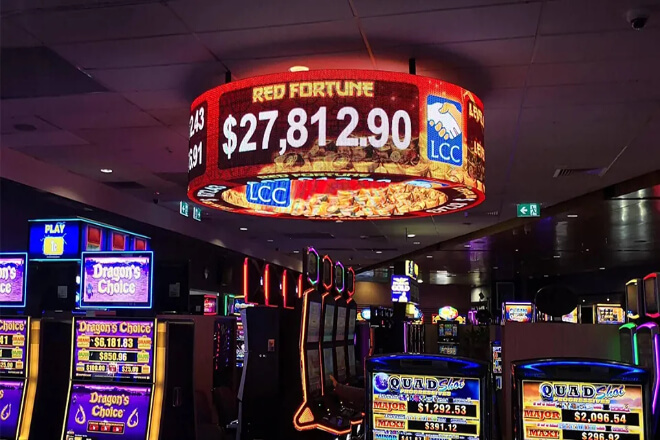
In a casino environment, if used skillfully, high-brightness LED displays are not just “brighter,” but more effective at “speaking.”
They can make advertising and guidance both natural and effective, attracting and engaging players unconsciously.
Firstly, high-brightness screens are ideal for highlighting key events and promotional information.
In relatively dim environments, a moderately bright screen acts as a “visual cue,” allowing content to be captured more quickly and preventing important information from being lost in the surroundings.
Secondly, dynamic visuals are key to attracting attention. Compared to static content, flowing images, rhythmic changes.
And visual transitions are more likely to grab your eye, like someone gently tapping you on the shoulder to remind you to “look here.”
This natural attraction is more effective than simply increasing brightness.
Furthermore, high-سطوع screens can enhance brand exposure and memorability.
When brand elements appear repeatedly in a clear, stable, and rhythmic manner, they are more easily remembered, rather than fleetingly.
Brightness here is not the goal, but a means to help the brand “be seen.”
Additionally, high-brightness screens can guide pedestrian flow. Through content changes and visual directional cues, players are naturally guided to certain areas.
Such as activity zones or popular game areas, acting like a silent but perceptive “spatial guide.”
Simply put, in casinos, high-brightness LED displays are not simply about being “brighter,” but about smarterly attracting attention, reinforcing memory.
And guiding behavior, ensuring that advertising doesn’t disrupt the experience while truly achieving its purpose.
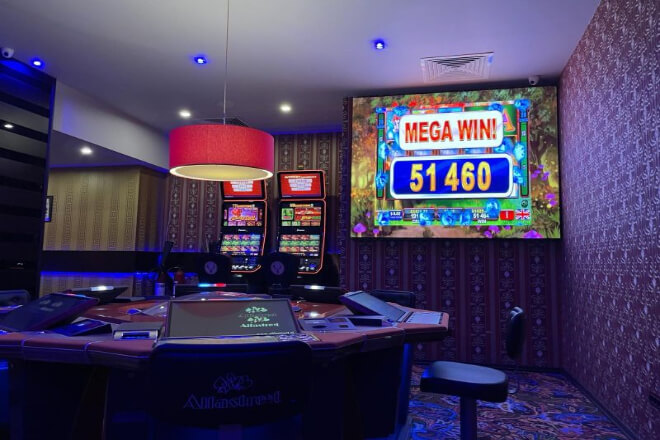
In a casino environment, the real challenge of high-brightness LED displays is not “whether they can be bright enough,” but “how intelligently they are bright enough.”
Used well, they are masters at attracting attention; used poorly, they can easily become an “overly enthusiastic presence,” making people want to avoid them.
First, different brightness strategies can be set according to different areas. Entrances and activity areas can be slightly “more active,” like a warm greeting at the door.
While game areas should be more restrained, letting the screen exist like background music, not stealing the show but always present. After all, not every corner needs “concert lights.”
Second, adjusting the display effect according to the time of day is also important. When there are many people, the display can be brighter and more dynamic to attract attention.
When there are fewer people or the stay is longer, the brightness can be reduced to make the image softer, giving the eyes a rest.
Just as lighting changes with the atmosphere, the screen also needs a sense of rhythm.
At the same time, the screen must be “in harmony” with the overall space design. Color, brightness, and content rhythm must all be consistent with the lighting and environmental style.
Otherwise, it’s like an inappropriate background music track—no matter how brilliant, it will feel jarring.
The ultimate key is finding a balance between “attractiveness” and “comfort.” It should be watchable without being disruptive; it should have presence without overshadowing the main content.
Simply put, in a casino, a high-brightness LED display is like a well-timed “lighting director”—knowing exactly when to shine and when to quietly accompany the scene.


 English
  Español
  简体中文
简体中文  Français
  日本語
日本語  한국어
한국어  العربية