
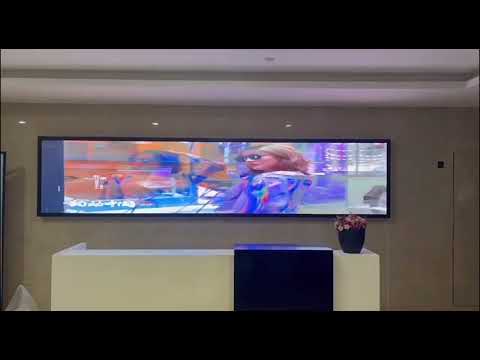
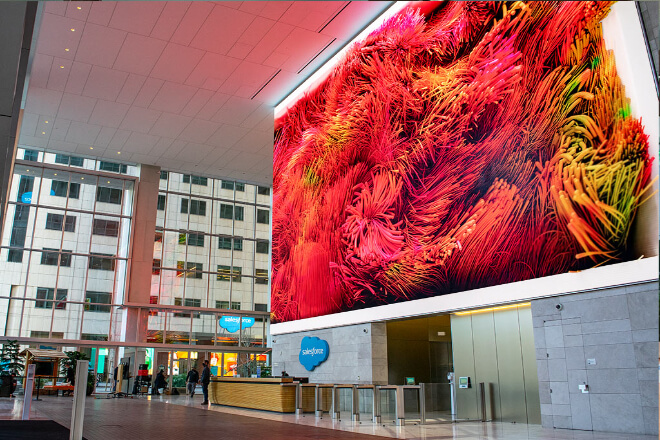
The LED screen in a corporate showroom is essentially not just a “video playback device,” but rather the main visual element that helps the company clearly and professionally convey its first impression.
First, use content to “explain” the corporate culture and core values more concretely.
For example, a company in the new energy sector wouldn’t just display “Green Future,” but rather use يعرض الصمام to create a dynamic timeline:
From laboratory R&D → first project implementation → nationwide deployment → future urban energy blueprint. Viewers see not just slogans, but a “development story.”
Second, maintain a unified brand visual style, making the showroom appear as a cohesive whole, not a patchwork.
For example, if a tech company’s main visual is blue with flowing light animation, then the LED content should also maintain this style:
Data flows across the screen, the logo appears with light and shadow, and title transitions have a consistent rhythm.
For instance, when introducing a product, if one screen looks like a “PowerPoint slideshow” while another looks like a “tech movie intro,” the difference in visual experience will be very noticeable.
At the same time, using visual details to enhance professionalism makes it easier for clients to build trust.
For example, when receiving clients, the screen can display a real-time map of the company’s global projects:
Locations in different countries light up one by one, or display a real-time operational data dashboard, making the “business scale” immediately apparent.
Simply put, without saying too much, the screen itself should “showcase” its strength.
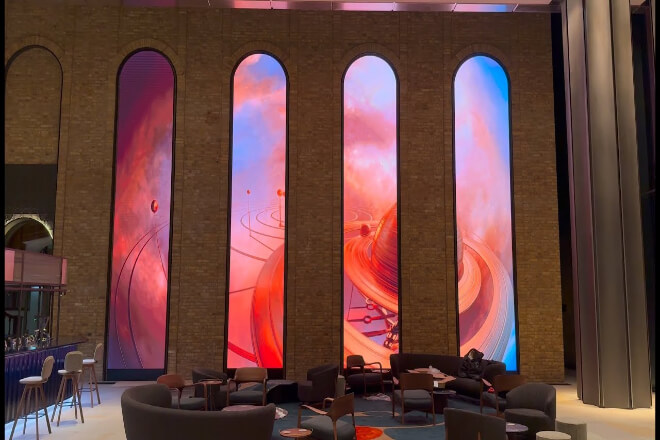
The biggest pitfalls for LED screens in a company lobby are either “too small to resemble an electronic photo frame” or “too large to look like it’s swallowed up by a wall.”
Therefore, the key is not “how big the screen is,” but rather—making the screen and the space appear to share the same design language.
First, the screen size must match the عرض المسافة to avoid an imbalance. For example, in a small reception area, a super-large screen only 3-5 meters away can create an overwhelming feeling of information overload.
In a large corporate atrium, a small screen might only show a “glowing logo” from a distance.
For instance, a 500㎡ hall is suitable for a medium-sized main screen, while a 2000㎡ atrium might require a main screen plus auxiliary screens to fill the space.
Second, the screen’s position determines the “first visual focus” and should be placed along the most logical visual path.
Typically, this is chosen directly opposite the entrance, against the reception backdrop, or in a centrally located position within the atrium.
Simply put, the goal is for customers to see the content the company wants them to see first, not just the reception desk.
If the placement is off-center, even the best content will only be seen as something passed by.
Furthermore, visual harmony must be ensured, allowing the screen to “integrate into the space,” rather than being “hung out” in it.
For example, if the lobby has a modern minimalist style, the screen can be embedded or have an ultra-thin bezel design.
If the space has a tech-oriented feel, a floating screen or a wraparound structure can enhance the futuristic feel.
For instance, the same screen looks completely different depending on whether it’s mounted flush against the wall or embedded in it.
Finally, enhance the overall quality of the space, making the screen “part of the space upgrade.”
Good design doesn’t just draw attention to “there’s a screen here,” but makes people feel—”this space should have had a screen like this.”
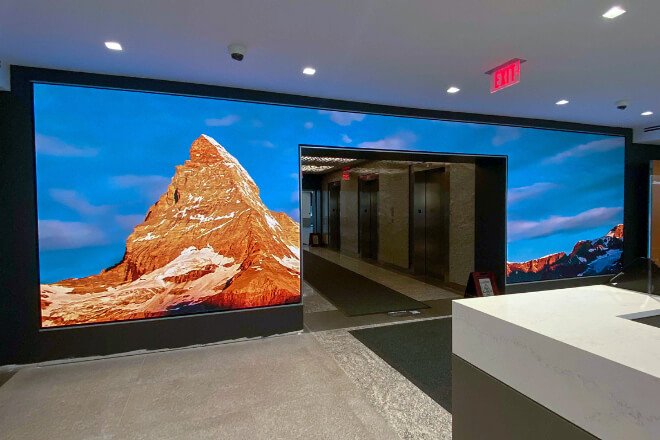
In corporate showrooms, the most common problem with LED screens isn’t that “the screen isn’t good enough,” but rather that the content is too haphazard, looking like a jumbled mess of information.
The same screen might show promotional videos, PPT presentations, and then switch to a slideshow of images, leaving viewers with only one impression: “Lots of content, but no focus.”
First, use corporate promotional videos, case studies, and displays of achievements to build the main content.
For example, a company could plan like this:
First, watch a 30-second brand promotional video upon entering (establishing a first impression).
Then, proceed to a core case study presentation (demonstrating “what you’ve done”).
Finally, showcase honors and qualifications (strengthening trust).
For instance, customers aren’t just “looking at the screen content,” but rather understanding step-by-step whether “this company is reliable.”
Secondly, avoid cluttered content; ensure information is rhythmic and hierarchical.
Many showrooms try to display everything, resulting in each item only appearing for 3 seconds, leaving the audience unable to remember the key points.
Simply put, an LED screen isn’t an “electronic bulletin board,” but a “content stage,” requiring a clear focus and rhythm.
Simultaneously, enhance the overall visual quality and strengthen professionalism through high-quality visuals.
For example, use cinematic corporate promotional videos, aerial footage of real projects, and data visualization animations, instead of simple image slideshows or text stacks.
For example, when introducing an engineering project, one uses PowerPoint screenshots, while the other uses aerial footage and animation; the level of trust is completely different.
Finally, enhance visitor impressions and trust, turning “seeing” into “remembering.” The value of high-quality content goes beyond simply “displaying information.”
It allows customers to quickly form a judgment: “This company is reputable, professional, and worth cooperating with.”
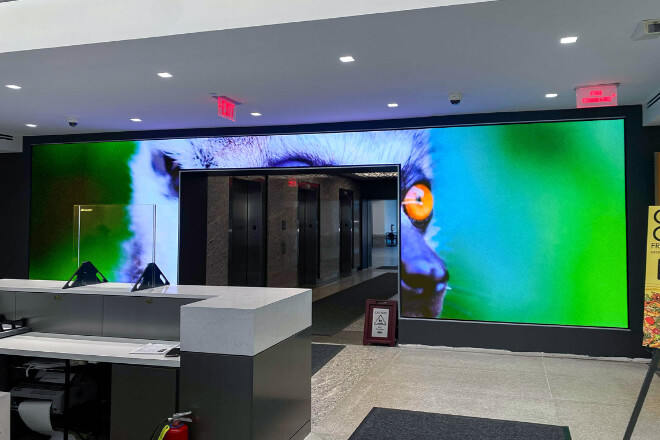
استخدام شاشات ال اي دي in a company lobby solely for “playing promotional videos” is somewhat wasteful.
A more advanced use is to make them also serve as an “information center,” both visually appealing and genuinely useful.
First, floor navigation, meeting schedules, and visitor guidance can be directly displayed on the screen, making information instantly understandable. على سبيل المثال:
“3rd Floor, Meeting Room A: Client Meeting in Progress.”
“5th Floor, Multifunctional Hall: 2:00 PM Press Conference”
“Elevator Directions: Right elevator to the upper floors.”
For instance, visitors entering the building don’t need to ask the receptionist; they can simply look up and know “where to go and when to go.”
Second, it improves information retrieval efficiency, freeing the lobby from repetitive manual explanations.
A common scenario in many company lobbies is that the receptionist is constantly “repeatedly answering questions.”
With LED digital wayfinding, routine information can be directly and standardizedly displayed, reducing communication costs. Simply put, it transforms “asking people” into “looking at a screen.”
Simultaneously, it enhances the company’s modern image, making the space feel more like an “entrance to an intelligent office system.”
Compared to traditional signage, dynamic LED wayfinding can update content in real time, such as ad-hoc meeting adjustments, visitor list changes, and event notifications.
For example, dynamically updated meeting schedules on the screen give clients the feeling that the company isn’t a “static office” but rather a “real-time operating system.”
Finally, this design has a hidden advantage: it upgrades the corporate lobby from a “display space” to an “operational space.”
It can receive clients, manage information, and showcase the brand.
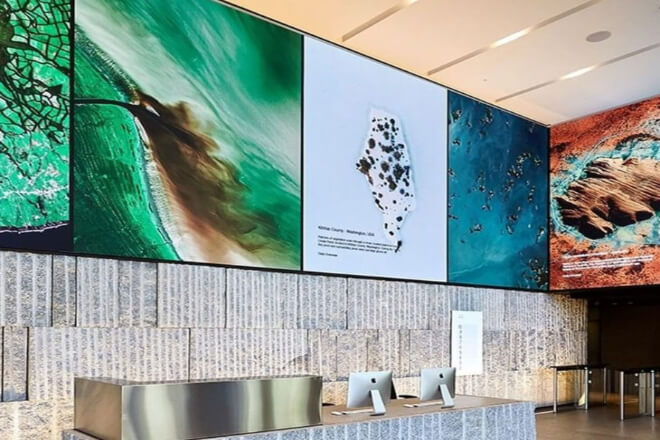
Many corporate lobbies install شاشات ال اي دي, but the problem isn’t that the screens are unattractive; rather, “a screen suddenly breaks the space’s ambiance.”
Even with high-end decor, a lit screen looks like a “stuck electronic billboard.” Therefore, the core principle here is: make the screen appear as if it naturally belongs to the space.
First, it must maintain a unified style with the lobby’s materials, lighting, and colors.
For example, if the space features warm wood tones and low-saturation lighting, then the screen content shouldn’t use overly glaring, high-contrast neon styles.
Conversely, if it’s a futuristic metallic space with cool lighting, then visual elements like blue-white light flows and data particles can be used.
For instance, the same screen might look futuristic in a “technology exhibition hall” but jarring in a “traditional lobby.”
Secondly, avoid making the screen a “visual island” and minimize any sense of jarring.
Many design failures stem from the fact that the wall and the screen are completely separate, lacking any transition.
A better approach is to use an embedded structure, a hidden bezel design, or to “wrap” the screen with LED strips or decorative lines.
Simply put, the goal is to make the viewer perceive the entire wall as a unified design, rather than “there’s a screen here.”
Furthermore, creating a more sophisticated spatial experience through a unified visual language.
For example, the company logo’s colors, font style, and animation rhythm should all be consistent with the spatial design, preventing the content displayed on the screen from feeling disjointed.
For example, when the data stream, lighting animations, and lobby lighting on the screen change in sync, the entire space feels more like a “breathing brand space.”
Finally, this integrated design has another crucial value: it transforms the LED screen from a mere “device” into “an integral part of the architecture.”


 English
  Español
  简体中文
简体中文  Français
  日本語
日本語  한국어
한국어  العربية