
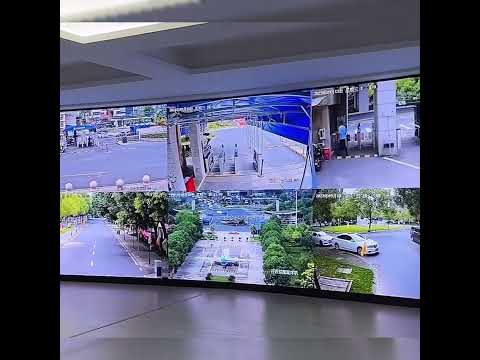
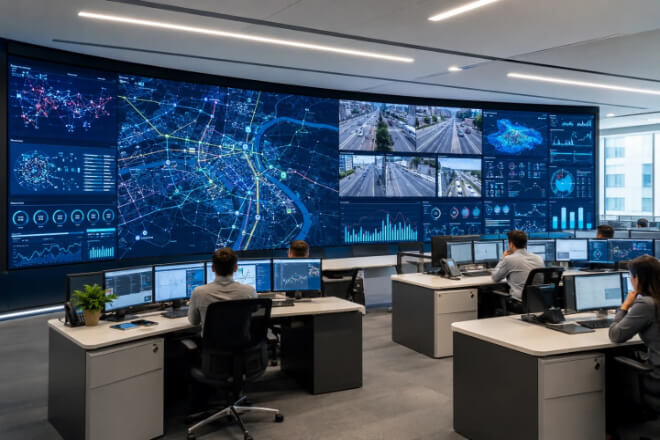
The large screen in a traffic command center isn’t simply about being “bigger is better.” Here, staff faces daily road monitoring, traffic flow, maps, and various real-time data.
The screen’s true purpose is to allow staff to quickly identify key information, not to turn an entire wall into a “glowing background.”
Before construction, it’s necessary to consider the hall’s height, the distance between the command center and the screen.
And the arrangement of the control panels to determine the شاشة ليد‘s size, proportions, and installation method.
For example, if the screen is too small, staff at a distance might have to squint to see the map;
However, pursuing an excessively large size could obstruct equipment, compress passageways, and even make the entire hall appear top-heavy.
If multiple surveillance feeds need to be displayed simultaneously, the splicing ratio must be planned in advance to ensure that maps, videos, data, and alarm information are rationally partitioned.
This way, staff can monitor traffic conditions in multiple areas simultaneously without frequently switching between screens.
Therefore, when selecting LED screens for traffic control centers, the key question isn’t “Can we install a bigger one?” but rather, “Can the person sitting at the control console comfortably see all the crucial information?”
Only when the size is truly appropriate will the large screen not just be “big,” but genuinely usable.
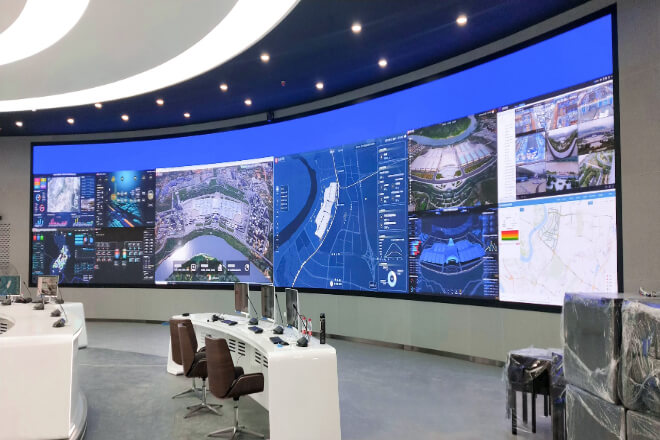
The large screens in traffic control centers aren’t for viewing scenery, but for displaying real-time traffic conditions, vehicle flow, surveillance footage, and various data.
If the image is blurry or the colours are off, staff might not be “looking at data,” but rather playing a guessing game with pixels.
Therefore, when configuring LED screens, it’s crucial to focus on pixel pitch, brightness, contrast, and colour reproduction.
مساحة وحدة الصورة should be chosen based on عرض المسافة to ensure clarity of roads on maps, vehicles in surveillance footage, and text in data reports.
سطوع should adapt to the lobby environment, guaranteeing clear information while avoiding excessive glare during prolonged viewing.
Simultaneously, the screen needs good colour consistency and image uniformity. For example, when monitoring footage from different areas is displayed simultaneously.
It shouldn’t be uneven, with some areas appearing darker and others brighter, and there should be no significant colour differences.
For staff requiring long-term monitoring, a stable and natural image is more important than simply pursuing “ultra-high brightness.”
Furthermore, glare and flicker issues cannot be ignored. Especially in command centers where dynamic monitoring is required for extended periods.
Significant screen flicker not only affects the viewing experience but can also increase staff fatigue.
Therefore, when selecting LED screens for traffic command centers, the real priorities are clear details, stable dynamic images, accurate colour reproduction, and no interference between multiple information streams.
A large screen isn’t just about “looking high-definition,” but about ensuring that every crucial data point is readily available to staff.
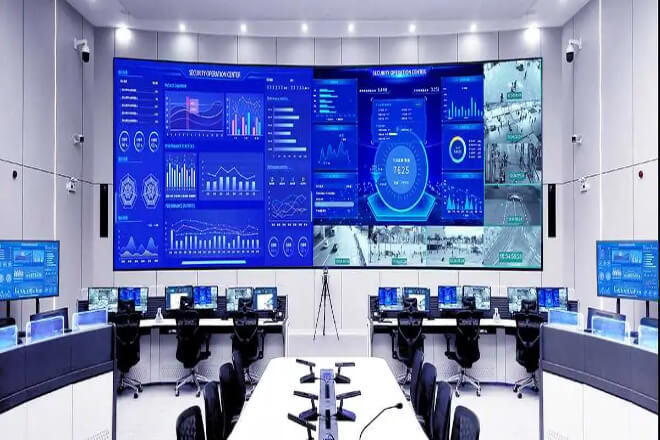
The true power of a traffic command center often lies not in its large screen, but in the “command brain” behind it.
ال شاشة ليد merely displays the information; its real function is enabled by the control system’s ability to seamlessly integrate road conditions, monitoring data, traffic lights, and early warning information.
During deployment, the focus is not simply on connecting a computer, but on ensuring the LED control system has excellent compatibility.
And can stably connect to traffic platforms such as road condition monitoring, checkpoint monitoring, signal dispatching, and emergency early warning.
This eliminates the need for staff to switch between multiple systems; a single large screen can simultaneously display information from various sources.
For example, during morning rush hour, it can display a real-time city congestion map while simultaneously playing surveillance footage from key intersections;
In the event of a sudden incident, it can quickly switch to emergency early warnings, accident area video, and dispatch information.
Making the entire assessment process more efficient, rather than staff scrambling to find the right window.
Furthermore, the control system needs to support screen splitting, signal switching, data linkage, and remote control to meet different working modes, including daily duty, meeting analysis, and emergency response.
Normally, it functions like a quiet information center, but when needed, it can quickly enter “full-capacity combat mode.”
Therefore, a good LED screen control system is like the director of a traffic command center.
The screen displays the images, while the control system decides when to display what, which images are most important.
And how to synchronize information, ensuring the entire traffic platform achieves truly efficient (interconnection/coordination).
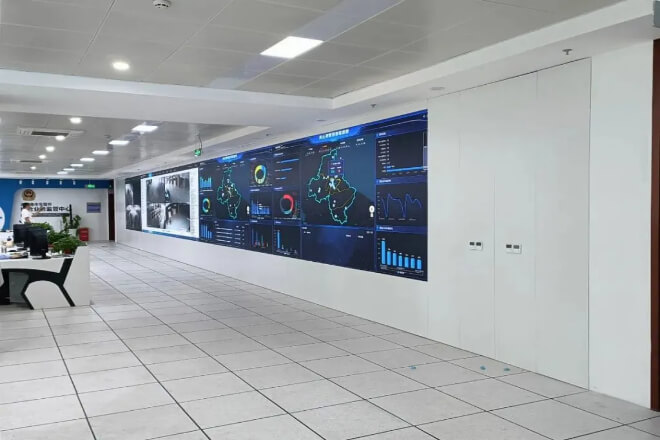
The large screen in a traffic command center is not simply a matter of “installing it and making it light up.”
It often needs to operate for extended periods, even 24/7. A sudden blackout, freeze, or system crash will affect more than just the viewing experience; it could directly impact traffic analysis and emergency dispatch.
Therefore, power supply, heat dissipation, and wiring must be planned in advance during the construction phase.
The power system must be stable, wiring must be properly laid out and concealed, and sufficient heat dissipation channels must be provided to prevent overheating after prolonged operation.
At the same time, dustproofing, moisture-proofing, anti-static, and power outage protection must be implemented to minimize potential risks to the equipment.
The hardware itself cannot be skimped on. Core components such as LED chips, power supplies, and drivers need to be selected as stable and reliable products to reduce the probability of failure during long-term operation.
For example, if the screen doesn’t dissipate heat properly after running continuously for several hours in summer, it might enter a “high-temperature rest mode” before the end of the workday.
Furthermore, wiring construction shouldn’t only consider “whether it works now,” but also the ease of future maintenance.
Clear wiring markings and standardized structures allow for quick problem location when they occur, rather than workers having to “guess which cable is which” amidst a jumble of wires.
Therefore, stable operation isn’t a matter of luck, but rather something built step by step from the construction phase. S
table power supply, good heat dissipation, clear wiring, reliable hardware, and adequate protection are essential for the شاشة ليد to truly withstand the 24/7 operation of the command center.
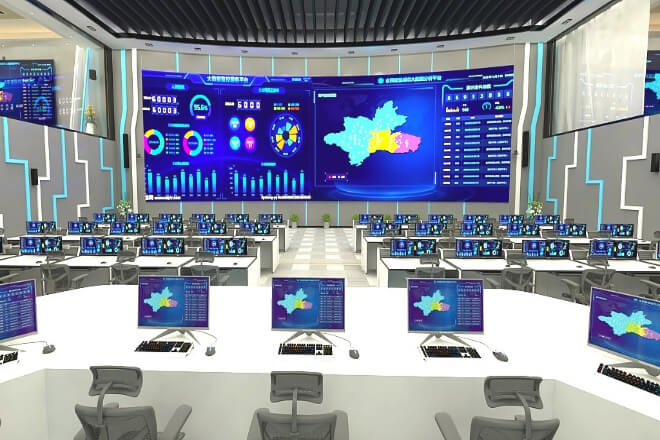
The completion of the LED screen installation doesn’t mean the project can be “handled off.” For traffic command centers, the real test occurs during long-term operation.
The screen receives real-time traffic conditions, monitoring footage, and various data daily.
If problems are only addressed temporarily when they arise, a simple fault can easily turn into a major on-site troubleshooting operation.
When a project is nearing completion, precise colour calibration, signal debugging, functional testing, and equipment acceptance must be completed first to ensure stable screen سطوع, colour, and clarity.
Simultaneously, functions such as multi-channel signal switching and split-screen display must be tested.
Especially for emergency scenarios, all operational procedures must be run through beforehand to prevent the screen from suddenly failing in unexpected situations.
Later, a simple and user-friendly operation and maintenance system needs to be established. Staff can learn daily use and basic troubleshooting through operation training, while the supplier provides technical support, spare parts service, and regular maintenance.
For example, if a module malfunctions, it can be quickly located and replaced, preventing a small screen from affecting the normal operation of the entire command center.
لذلك، شاشة ليد maintenance is not about “fixing after it breaks,” but about proactive inspection, timely handling, and adequate support.
This way, the large screen can operate reliably, allowing staff to dedicate their time to truly important traffic management, rather than engaging in daily “who will surrender first” battles with the screen.


 English
  Español
  简体中文
简体中文  Français
  日本語
日本語  한국어
한국어  العربية