

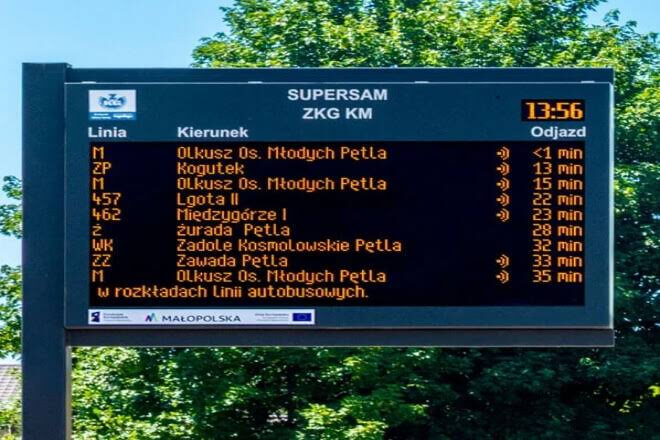
Waiting for the bus at a bus stop often causes anxiety—especially on rainy days or when in a hurry.
يعرض الصمام act like a helpful companion, making information readily available and providing passengers with peace of mind.
For example, a real-time display of bus arrival times. The screen dynamically updates the estimated arrival time for each bus.
Eliminating the need for passengers to stare blankly at intersections or guess when it will arrive.
Imagine a bus stop near the Beijing subway station where an LED screen displays “Bus No. 23, arriving in 2 minutes”—even in a downpour, you can confidently wait with an umbrella.
Another example is displaying information on schedule changes and delays. When encountering traffic jams or route adjustments.
The screen will immediately display messages such as “Route 14 delayed by 5 minutes” or “Temporary detour,” eliminating the need for passengers to ask around or miss their bus due to delayed information.
Meanwhile, displaying route maps and transfer information is especially helpful for passengers unfamiliar with the routes.
The screen clearly shows the route, station locations, and transfer options, making it easy to plan your trip.
It can even casually tell you which routes have better scenery or which stops have coffee shops—of course, this depends on how thoughtfully the screen content is designed.
Simply put, the LED displays at bus stops are more than just “announcing times.”
They act as a travel assistant that makes waiting less boring, provides clear and reliable information, and gives passengers less anxiety and more control.
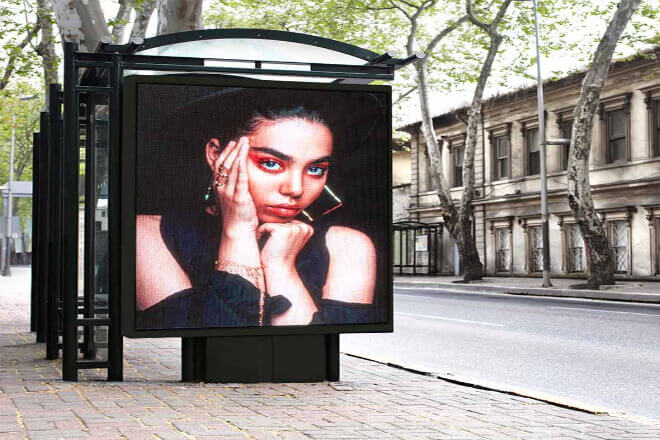
For many passengers, the worst thing about taking the bus isn’t traffic jams, but rather being distracted by their phones and missing their stop.
The existence of LED displays inside the bus is precisely to make travel easier and more worry-free.
Firstly, the LED screen can display real-time information about the next stop and route progress.
Before the vehicle arrives, the station name, transfer routes, and current location will be displayed in advance, allowing passengers to keep track of their journey.
Especially when traveling in an unfamiliar city, there’s no need to constantly open a map to confirm the location; a glance at the screen tells you how many stops are left to your destination.
Secondly, it can also provide timely safety information and riding etiquette reminders.
For example, reminders like “Please hold on tight when the vehicle turns” and “Please take your belongings with you when you get off” may seem simple, but they effectively improve passenger safety.
During peak hours, this type of information is often more intuitive and easier to notice than announcements.
Beyond basic travel information, the شاشة ليد can also provide practical content such as weather forecasts, news, and holiday reminders.
For example, when going out in winter, the screen can display “Today’s temperature is dropping, please dress warmly.”
Seeing “Rain is expected in the next two hours” before getting off allows passengers to prepare rain gear in advance.
Although it’s just a few seconds of information, it makes the entire journey more considerate.
In short, the in-vehicle LED display is like a “little helper” on the bus: telling you where you are, reminding you of things to pay attention to.
And providing some practical information, making the otherwise ordinary journey more comfortable and relaxed.

For passengers, LED displays are a window to information; but for bus operators.
They are more like the “information hub” of the entire public transportation system, helping managers to monitor operations in real time and improve dispatching efficiency.
أولاً، يعرض الصمام can show vehicle status and operational data in real time.
Information such as vehicle location, departure intervals, passenger flow, and route operation status can all be displayed simultaneously.
For dispatchers, this is equivalent to having a “real-time traffic map,” allowing them to quickly identify areas of overcrowding and insufficient capacity.
Second, it supports information dispatching from the command center. In the event of large-scale events, severe weather, or sudden traffic emergencies.
The management center can quickly issue dispatch instructions through the system.
For example, if a route is temporarily detoured due to road construction, relevant information can be simultaneously transmitted to stations, vehicles, and platform displays in real time, reducing information transmission delays.
Simultaneously, LED displays can also improve operational efficiency and emergency response capabilities.
For example, during morning and evening rush hours, if the system detects a significant increase in waiting numbers at a certain stop.
Operators can promptly increase the number of buses or adjust vehicle distribution to avoid long waiting times.
Compared to traditional manual statistics, this data-driven management is clearly more efficient.
With the development of المدن الذكية, LED displays are becoming an important component of intelligent transportation systems.
They not only connect vehicles, stations, and dispatch centers, but also enable real-time information flow, helping the entire public transportation network operate more smoothly.
Simply put, the value of LED displays for public transportation management lies in enabling dispatchers to see clearly, react quickly.
And manage accurately, thus making public transportation operations smarter and passenger travel smoother.
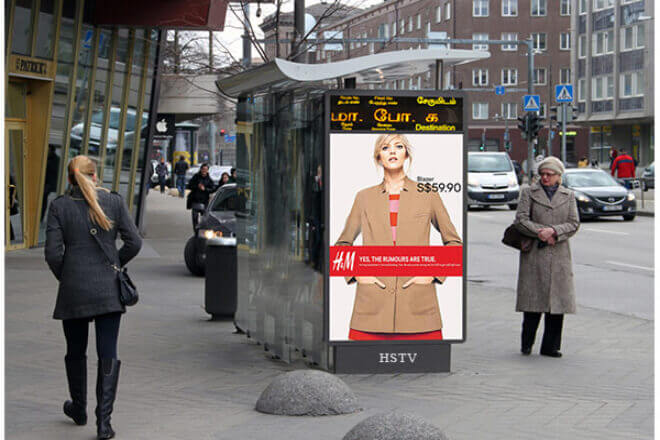
Modern bus stations and in-vehicle LED displays are no longer just “stop announcement tools.”
They can become an interactive bridge between passengers and public transportation, making the travel experience more considerate and enjoyable.
First, the screens can provide interactive information query functions. For example, passengers can use touch or QR code scanning to check the next bus, route planning, and transfer options.
Passengers don’t need to search through paper route maps or constantly ask staff for personalized information.
Imagine a new resident who has just moved to the city, directly finding the shortest transfer route through the station’s LED screen—wouldn’t that save time and effort?
ثانيًا، شاشات ال اي دي can also display public service announcements and city event notices. The screens can display real-time traffic safety tips, environmental protection initiatives.
And information on nearby community activities, exhibitions, and festivals, allowing public transportation to not only deliver travel information but also convey the warmth of the city.
For example, during festivals, LED screens can display friendly reminders like “Take the bus, travel green, and have a happy holiday,” which is both practical and thoughtful.
Simultaneously, it can also support advertising and commercial information display, providing revenue streams for city operators and partners.
Advertising content can be precisely targeted based on passenger interests and time periods.
For example, displaying coffee shop discounts during rush hour serves passengers and increases commercial value.
Overall, LED displays enable the public transportation system to not only “announce stops” but also “communicate and interact,” making public transportation feel smarter and more considerate to passengers.
In short, it transforms every wait or ride from monotony into an experience where passengers can participate, obtain information, and even discover surprises.
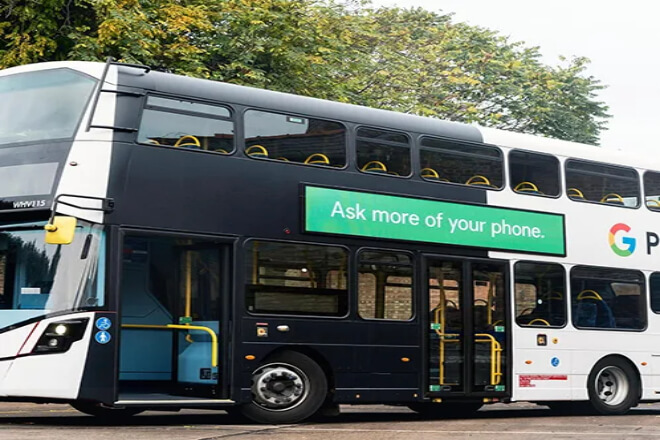
LED displays not only improve the passenger experience but also open up new revenue streams for public transportation systems, transforming buses from mere transportation tools into mobile commercial platforms.
Firstly, they can display advertisements and partner brand content. Whether it’s large screens at bus stops or LED screens inside buses, they can play brand promotions, special offers.
Or local business information, allowing passengers to naturally receive commercial information while waiting or riding the bus.
For example, during the morning rush hour, playing coffee shop promotional ads can perfectly reach commuters waiting for their caffeine.
ثانيًا، شاشات ال اي دي support precise advertising. The system can intelligently push suitable advertising content based on station passenger flow, time of day, and even route type.
For example, on tourist routes, screens can display recommendations for nearby restaurants or attractions, catering to passenger needs and increasing ad conversion rates.
Furthermore, these advertisements and content can increase revenue streams, providing additional income for public transportation operators and helping to optimize operating costs.
LED screens are not just information display tools but also carriers of value creation.
Finally, through modern and dynamic screen displays, the image of the public transportation system is also enhanced.
Compared to traditional billboards, LED screens offer a more high-tech and dynamic look, making urban public transportation appear more modern and intelligent.
Simply put, the LED displays in a public transportation system are like a money-making “smart window”:
Enhancing the passenger experience while creating commercial value for operators, transforming public transportation from a mere means of transport into a منصة showcasing urban intelligence and commercial potential.


 English
  Español
  简体中文
简体中文  Français
  日本語
日本語  한국어
한국어  العربية