
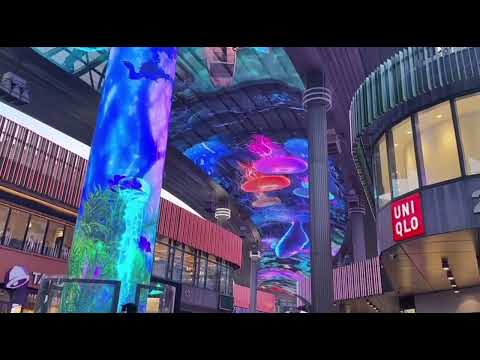
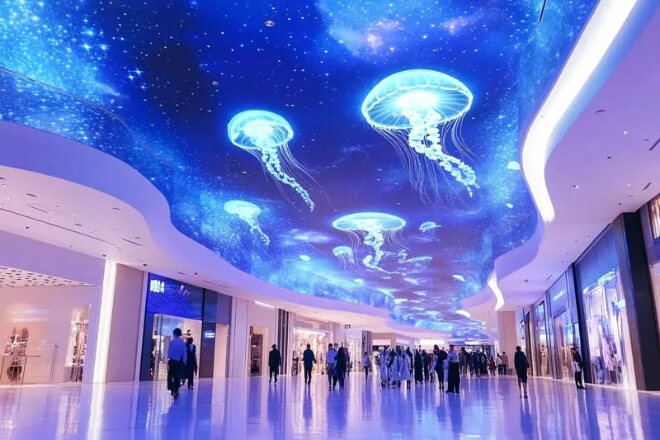
The most challenging aspect of LED canopy displays isn’t their size, but rather the fact that they have to deal with several different “light moods” throughout the day:
Intense sunlight in the morning, the most glaring light at midday, and ambient lighting at night.
First, maintaining high سطوع and visibility in strong daylight conditions ensures the image can withstand the sun.
على سبيل المثال، في مركز تجاري with a glass dome, direct sunlight can render the image essentially invisible if the brightness is insufficient.
A good canopy display automatically increases the brightness, ensuring the content is clearly visible even when looking up from below.
For instance, even under bright sunlight outside, the screen can still clearly display new product animations, like “a high-definition cinema in the sunlight.”
Secondly, it automatically reduces brightness at night to avoid becoming a source of light pollution. If the brightness remains at daytime levels, it easily becomes the most glaring light fixture in the room.
With intelligent dimming, the image becomes softer, resembling a light show rather than an advertising screen.
For example, when shopping at night, you might see a gentle starry sky animation instead of a barrage of blinding advertisements.
Simultaneously, it intelligently adjusts to changes in natural light, allowing the screen to “learn to read the weather.”
For instance, it automatically brightens on cloudy days and increases brightness on sunny days, even fine-tuning the contrast at different times of day.
Simply put, the screen adapts to its environment, eliminating the need for constant manual parameter adjustments.
Finally, it ensures stable readability throughout the day, keeping content consistently clear and comfortable to view.
Whether under strong morning light, afternoon sun, or ambient lighting at night, the image remains bright and clear without flickering or obscuring details.
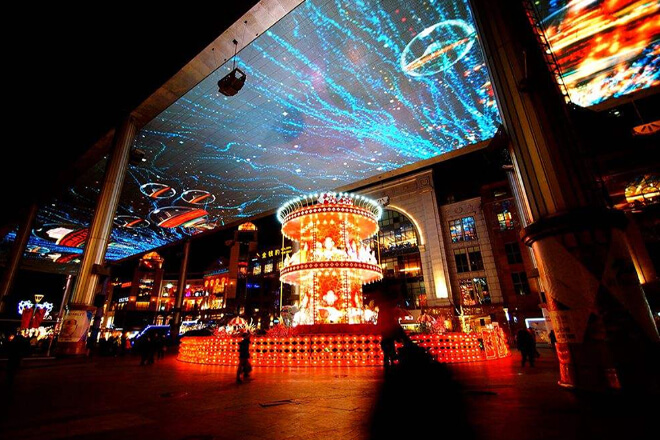
The most demanding aspect of a sky-canopy LED display isn’t actually the content it displays, but rather the fact that it’s almost constantly “working” without experiencing any heat issues.
After all, heat can easily affect the image quality, and in severe cases, even cause it to “drop out of focus.”
First, a heat dissipation design for high-temperature environments prevents the screen from becoming a “heat source.”
على سبيل المثال، في shopping mall’s large canopy screen with densely packed LEDs, if heat cannot dissipate, the image may appear dim or blurry.
A good design uses a heat dissipation structure to quickly conduct heat away, like installing an “invisible fan system” on the screen, constantly and quietly cooling it down.
Second, a modular structure improves airflow, preventing heat from getting trapped inside.
Canopy screens are usually assembled from individual modules, creating natural “breathing space” between them.
For example, like assembling Lego bricks, they aren’t crammed together in a completely airtight manner, but rather have channels for airflow, allowing heat to escape along these pathways.
Simultaneously, it ensures that performance doesn’t degrade during extended playback, making the screen “more stable with use.”
For example, shopping mall canopies may continuously play advertisements, holiday animations, and brand content for over ten hours a day.
If heat dissipation is stable, سطوع و معدل التحديث won’t decrease due to heat, resulting in a consistently clear and stable image.
Finally, reduce the risk of overheating and avoid the situation where “the hotter it gets, the less stable it becomes.”
Many display problems are not actually content issues, but rather performance fluctuations caused by excessive temperature.
After stable heat dissipation, even after long-term operation, the screen will not suddenly dim, flicker, or lag.
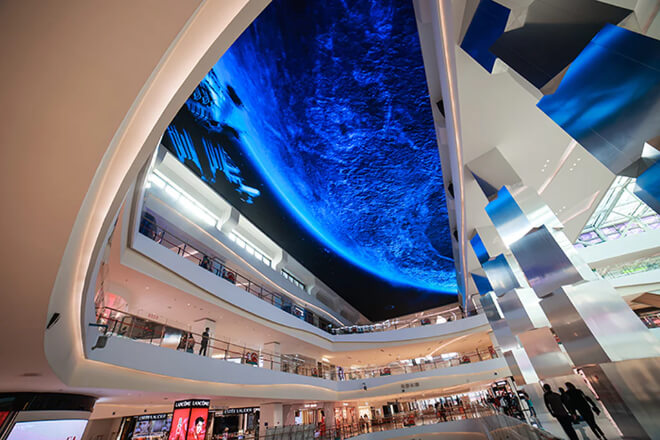
A key characteristic of sky-mounted LED displays is that they don’t just “play occasionally,” but rather play content all day long.
Therefore, the key is not just “what to play,” but how to make it play the right content rhythmically.
First, preset multiple content playback schemes so that the screen “has a script to perform.”
على سبيل المثال، مراكز التسوق can present: brand promotions in the morning, food and beverage promotions at noon, and atmospheric visual content in the evening.
For example, when you enter the mall in the morning, you see new product promotions; at noon, you see “lunch discounts.”
And in the evening, you look up and see a starry sky or holiday animation—the same screen, like it has three different “personalities.”
Second, automatic scheduling and loop control make playback “as precise as a timetable.” The system will automatically switch content according to time periods, without requiring constant monitoring and adjustments.
For example, it can display a set of advertisements every 15 minutes and insert mall event information every hour on the hour, acting like an “automatic announcer”—punctual, reliable, and error-free.
Simultaneously, it supports quick switching between holiday and event content, allowing the screen to “change themes” at any time.
For instance, Christmas can be switched to a snowflake and gift theme with a single click, Mid-Autumn Festival to a moon and lantern theme, and an anniversary celebration to a countdown and main visual packaging.
Simply put, there’s no need to redesign the entire process; it’s just a “skin change.”
Finally, it reduces manual intervention and improves overall operational efficiency.
Previously, content updates and playback checks might have required manual intervention; now, most of this can be done automatically by the system.
Staff only need to preset the content logic, and the screen will “work according to plan.”
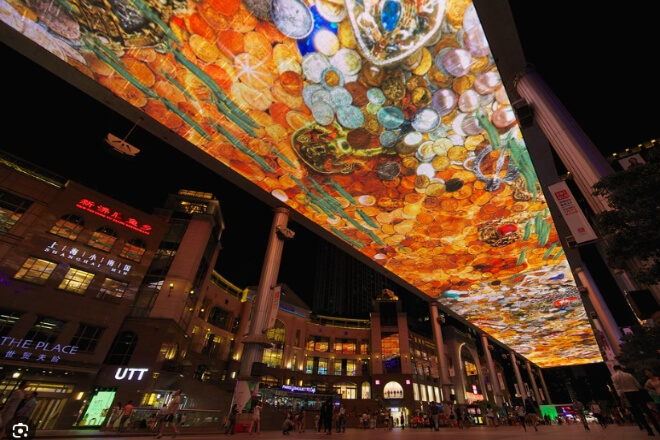
Sky Screen LEDs are somewhat like “large screens hanging in the sky.” Once a problem occurs, it’s not the kind of equipment that can be easily repaired.
Therefore, one of its core capabilities is allowing people to know if it’s “in good condition” without having to climb up to check it every day.
First, a centralized control system ensures unified management, allowing all Sky Screens to “follow the same command.”
For example, a large مركز تجاري might have more than one canopy screen, but through a single control platform, content, brightness, and playback modes can be uniformly adjusted.
For instance, headquarters can simply click on “Holiday Mode,” and the entire canopy instantly transforms into a festive visual environment, eliminating the need to operate each screen individually.
Secondly, real-time monitoring of operational status ensures problems are detected before they escalate.
The system continuously monitors indicators such as temperature, voltage, brightness, and module status.
If an area exhibits an anomaly, such as excessively low سطوع or high temperature, the backend will immediately issue a notification. Simply put, the screen itself “reports its health status.”
Simultaneously, fault warning and rapid response mechanisms prevent small problems from escalating.
For example, if a module becomes unstable at the outset, the system will issue an early warning, rather than waiting until the entire screen goes black.
Some systems can even automatically switch to backup content or reduce load to ensure uninterrupted visuals.
Finally, it reduces maintenance costs and downtime risks, making operations more worry-free.
Because many problems can be diagnosed and even handled remotely, maintenance personnel no longer need to frequently climb to the site for inspections, significantly reducing overall maintenance costs and downtime.
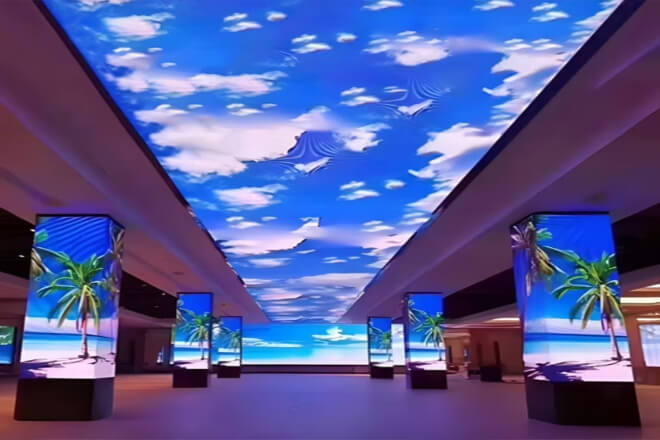
The role of canopy LED displays in مراكز التسوق is not merely aesthetics.
It’s about working in sync with the mall’s rhythm—driving traffic when needed and creating atmosphere when appropriate.
First, a dual-mode system—daytime traffic generation and nighttime atmosphere creation—allows a single screen to “sell during the day and create ambiance at night.”
For example, during peak daytime hours, the canopy displays more information on new products, discounts, and events.
At night, as the pace of foot traffic slows, it switches to light shows and brand visual animations.
For instance, seeing “limited-time offers” during the day and “flowing stars” at night creates completely different feelings.
Second, content is dynamically updated to match mall events, keeping the screen “on trend.”
For example, for anniversaries, pop-up stores, and holiday activities, the canopy content can be quickly adjusted to the corresponding themes.
Simply put, whatever the mall’s activities are today, the canopy “speaks in sync,” ensuring the space and activities are not disconnected.
Simultaneously, it improves the overall utilization of commercial space, making “the ceiling work too.”
Previously just a structural element, the ceiling now becomes a medium for continuously outputting content.
For example, when customers are browsing, queuing, or resting, they see brand and event information everywhere they look, essentially making the entire space “do business” for the mall.
Finally, enhancing the customer experience encourages them to stay longer.
For instance, displaying gently rhythmic dynamic visuals on a canopy or creating immersive visual scenes during holidays will unconsciously slow people down, prompting them to stop for photos or rest.
Often, the longer people stay, the higher the probability of a purchase.


 English
  Español
  简体中文
简体中文  Français
  日本語
日本語  한국어
한국어  العربية