
مقدمة
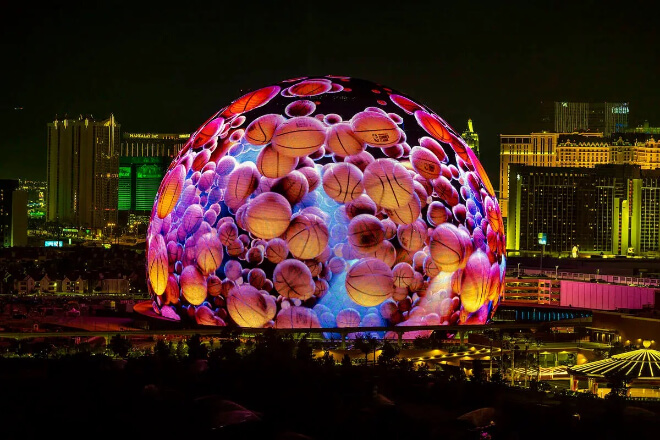
Have you noticed that some buildings now look more than just “beautifully designed”—they seem to move, change, and even “tell stories”? How are these effects achieved?
Traditional materials struggle to achieve this, but شاشات LED مرنة are slowly changing that.
So how exactly are they used in creative architecture? There are actually quite a few possibilities.
جدول المحتويات
Application 1: Creating Dynamic Building Facades
The most interesting aspect of شاشات LED مرنة in creative architectural design is that they truly bring buildings to life.
Unlike traditional LED screens, which can only be attached to flat surfaces, flexible LEDs can be bent and conform to various curved surfaces and irregular structures.
Whether it’s a curved exterior wall, a streamlined shape, or a highly designed architectural silhouette, it can be applied seamlessly, like giving the building a luminous “coat.”
Because of this, the building facade is no longer just a static “shell,” but becomes a giant dynamic canvas.
It can display flowing light and shadow, gradient colors, brand animations, and even artistic videos.
By day, it’s a strikingly designed building; but at night, when it’s illuminated, the entire wall transforms, some parts resembling flowing water, others like breathing light, captivating the eye from afar and drawing attention.
This effect is particularly common in commercial centers and city landmarks. On one hand, it’s undeniably eye-catching, easily becoming a popular spot for photos; on the other hand, it gives the building more expressive power.
For example, it can change its atmosphere for holidays, showcase the entire facade for brand events.
And even switch content according to different times of day, making the building slightly different every day.
Even more interestingly, this design transforms the building from a cold, impersonal entity into something with character.
It can be quiet or bustling; understated or incredibly striking. For the city, this dynamic facade enriches and adds depth to the nighttime skyline.
Simply put, flexible LEDs transform buildings from “static sculptures” into dynamic, expressive entities.
It’s not just about aesthetics; it’s about making them more interesting and memorable.
Application 2: Constructing Curved or Wavy Architectural Media Walls
If traditional LED screens are still limited to “flat displays,” then flexible LEDs are essentially “unlocking new shapes.”
Their flexible modules can be bent freely, no longer limited to square screens, but can be made into curved, wavy, or even more complex three-dimensional structures.
For architecture, this is not just “adding a screen,” but adding another material that can participate in design.
For example, in some commercial projects, you’ll see that exterior walls are no longer straight, but undulating like water ripples, or forming streamlined curved surfaces.
These shapes are difficult to achieve with traditional screens, but flexible LEDs can conform to the structure, allowing the entire media wall to have both shape and display content.
The image flowing on the curved surface creates a unique three-dimensional effect, appearing more layered and impactful than ordinary flat screens.
This “non-flat” display method is actually quite eye-catching.
Because people are used to square screens, the appearance of curved or wavy dynamic images feels fresher and more design-oriented.
Especially at night, the light and images flow along curves, somewhat like light “wandering” across the building’s surface, creating a more interesting visual effect.
From a design perspective, this application also greatly enhances the building’s artistic and technological feel.
The screen is no longer just an information carrier, but becomes part of the building’s form, even a visual focal point.
For brands, such media walls are easier to remember; for cities, they provide more personalized and futuristic spaces.
Simply put, flexible LEDs transform the “screen” from a flat tool into a design element that can participate in the overall form.
Whether it’s an arc or a wave, it’s not just about aesthetics, but also about making the building itself more imaginative.
Application 3: Integration into Commercial Buildings and Shopping Mall Design
The use of flexible LED displays in commercial spaces is particularly “flexible.”
Unlike traditional screens that can only be mounted on walls or used as a large screen, flexible LED displys can be attached to various structures.
For example, they can be seamlessly integrated into the pillars, curved railings, and even ceiling designs of مركز تجاري atriums without appearing out of place.
Imagine a shopping mall atrium where the pillars are no longer just ordinary decorations, but dynamic carriers capable of displaying content.
Or look up and see the ceiling not only illuminated but also slowly changing images—this is a truly novel experience.
Because the screen is no longer just an “add-on,” but integrated into the entire spatial design, it subtly draws people in.
The content can also be very flexible. It can play brand advertisements, event information, new product launches, and even create atmospheric visual content to coincide with holidays.
For example, during holidays, the atrium screen changes along with the surrounding decorations, instantly elevating the atmosphere of the entire space—more impactful than simply displaying decorations.
This approach is a significant advantage for shopping malls. On one hand, it enhances the overall visual appeal of the space, encouraging people to linger and browse longer.
On the other hand, it provides brands with more display opportunities, no longer limited to store entrances, but allowing them to “appear” throughout the entire space.
In short, flexible LEDs make commercial spaces not just “easy to browse,” but more visually appealing and dynamic.
As customers walk through, they are constantly drawn to the new visuals, and this experience itself generates brand exposure.
Application 4: Creating Iconic Digital Landmarks
شاشات LED مرنة have another groundbreaking application—transforming buildings into iconic urban landmarks.
They’re not just displayed on the exterior walls; they participate in the architectural design itself, making the entire building stand out.
Because flexible LEDs can conform to various curved surfaces and complex shapes, designers can be bolder, creating streamlined facades.
Curved structures, and even futuristic appearances, giving the building a “star attraction” from the start.
The truly fascinating moment is when it “lights up.” During the day, you might just think the building’s design is unique.
At night, the entire facade begins to glow and change, with images flowing across the building—some resembling water, others like running light—looking like a giant digital art installation.
Passersby are almost inevitably drawn to take a second look, perhaps even taking out their phones to snap a picture, easily turning it into a popular urban photo spot.
Moreover, this type of architecture is “changing.” Today it features brand content, tomorrow it can change to a holiday theme, and for large events.
The entire exterior wall can be synchronized, giving the building a sense of daily variation and preventing it from becoming tiresome.
Compared to the “fixed image” of traditional landmarks, this dynamic landmark is more interesting and generates more buzz.
From an urban perspective, this design is a significant plus. It enriches the nighttime view, enhances the technological feel, and provides an additional window for showcasing content.
Over time, such architecture becomes more than just a location; it becomes a “changing business card” for the city.
Simply put, flexible LEDs make architecture not just “look special,” but “live special.” It’s not just something to see; it changes, and it’s easier to remember.
5. الخاتمة
In summary, flexible LED displays offer architecture a completely new way to express itself.
Whether it’s creating dynamic facades, curved media walls, integrating into commercial spaces, or building urban landmarks, it transforms architecture from something “seen” to something that “expresses itself.”
When design is no longer limited by plan and structure, architecture becomes more imaginative.
With their visual impact, engaging design, and memorable features, flexible LEDs are increasingly appearing in creative architecture.
وأخيرًا، لمزيد من المعلومات حول شاشات LED، يرجى الحصول على اتصال معنا.
 English
  Español
  简体中文
简体中文  Français
  日本語
日本語  한국어
한국어  العربية