
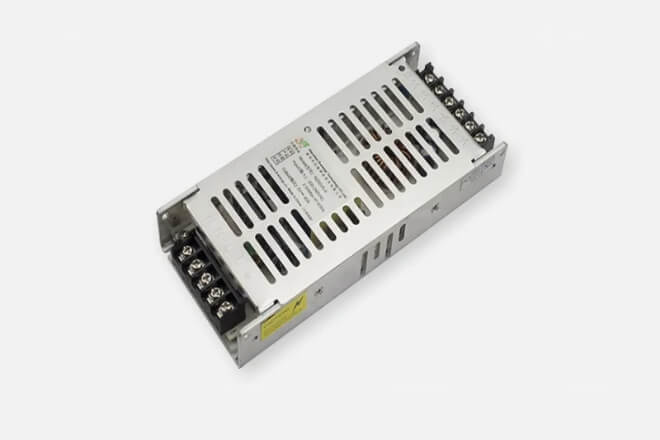
When purchasing an LED display, many people focus on comparing LED beads, pixel pitch, and refresh rates, while often overlooking a critical component hidden behind the screen: the power supply.
Although it is not responsible for rendering the image, the power supply determines whether the other components receive stable power.
So, does the quality of an LED display’s power supply actually affect its lifespan?
If an LED display were a musical ensemble, the LED beads would be the musicians playing the melody.
And the driver chips would be the rhythm section—while the power supply acts as the energy system fueling the entire band.
Even if every musician is highly skilled, an unstable energy supply can severely compromise the final performance.
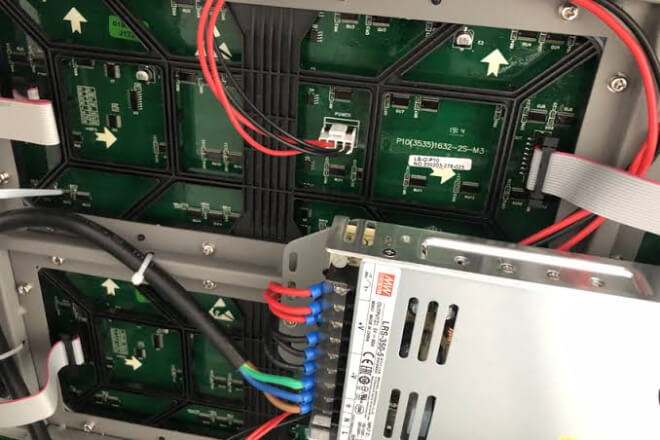
An LED display consists of numerous electronic components, including LED beads, driver chips, receiving cards, and control systems.
These components require a stable DC voltage to function correctly.
The primary role of the power supply is to convert incoming AC power into the DC power required by the equipment, while maintaining a consistent output during operation.
A low-quality power supply may suffer from issues such as voltage fluctuations, excessive ripple, or insufficient load capacity.
Such irregularities can not only affect screen brightness and display stability but also place additional stress on other electronic components.
For instance, when an LED display shows high-brightness content for an extended period, its power consumption fluctuates based on the displayed imagery.
If the power supply cannot reliably handle these load changes, it may result in screen flickering, localized anomalies, or even a protective shutdown.
Therefore, the power supply for an LED display is not merely a generic accessory where costs can be easily cut.
While it does not directly dictate image clarity, it is essential for ensuring the screen’s long-term, stable operation.
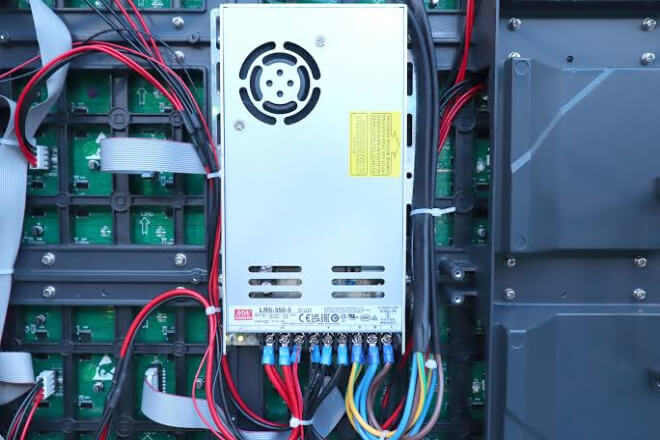
A problem with the power supply does not necessarily mean the screen will stop working immediately.
Some underlying issues may first manifest as intermittent, minor anomalies, only to evolve into significant, obvious failures over time.
To begin with, an unstable output voltage can negatively impact display quality.
LED beads and driver circuits must operate within specific electrical parameters.
Abnormal fluctuations in the supply voltage can lead to inconsistent brightness, screen flickering, or localized display anomalies.
The specific manifestations depend on factors such as the power supply design, driver circuitry.
And protection mechanisms; therefore, it cannot be assumed that all display issues are caused by the power supply.
Furthermore, overheating of the power supply can accelerate the aging of internal components.
Power supplies generate heat during operation. If internal components are of mediocre quality, conversion efficiency is low.
Or thermal management is inadequate, prolonged operation at high temperatures can accelerate the degradation of components—such as capacitors and power devices—thereby increasing the risk of failure.
This is particularly critical for LED displays installed in outdoor enclosures, confined spaces, or areas with poor ventilation, where heat dissipation for the power supply warrants extra attention.
Additionally, insufficient protection capabilities can exacerbate the impact of a failure.
High-quality, reliable power supplies are typically equipped with safeguards against overvoltage, overcurrent, short circuits, and overtemperature.
In the event of an anomaly, these mechanisms can help mitigate the risk of equipment damage.
Conversely, if a power supply lacks necessary protection or features an inadequate protection design, abnormal loads or electrical faults can cause more extensive damage to the power supply itself and its associated circuitry.
Moreover, power supply failures can lead to increased maintenance costs.
For commercial advertising screens and large-scale information displays, equipment downtime entails not only repair expenses.
But also potential disruptions to advertising broadcasts, scheduled events, and routine business operations.
If power supply failures recur, maintenance personnel must spend a significant amount of additional time troubleshooting and replacing components.
In the long run, selecting a reliable power supply for an LED display is generally a more prudent choice than focusing solely on a lower initial purchase cost.
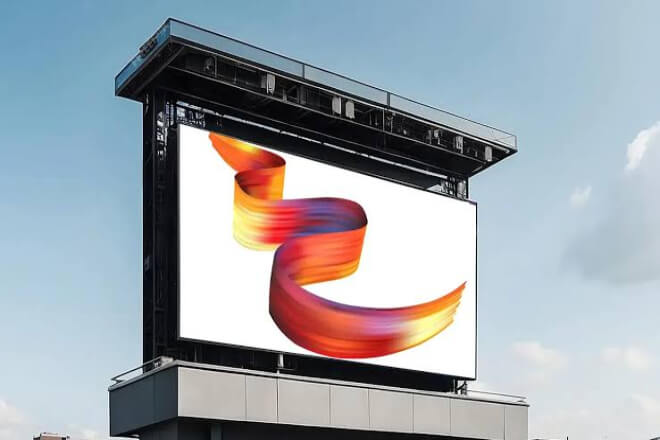
The quality of a power supply cannot be judged by its appearance alone, nor can it be determined by a single power rating figure.
When procuring LED displays, organizations can evaluate power supplies based on the following criteria:
Because different types of LED displays operate in varying environments and have distinct load characteristics, the choice of power supply cannot follow a “one-size-fits-all” approach.
- Indoor LED displays:
In settings such as conference rooms, exhibition halls, and command centers, there is typically a high demand for visual stability and continuous equipment operation.
When selecting power supplies, prioritize output stability, conversion efficiency, and thermal performance to prevent power-related issues that could disrupt critical meetings or information displays.
- Outdoor LED displays:
Outdoor advertising displays are frequently exposed to high temperatures, humidity, and fluctuating weather conditions.
Beyond meeting output requirements, the power supply must feature protection and thermal management designs suited to the installation environment.
For outdoor projects, one should not look only at the power supply’s individual specifications;
It is also necessary to evaluate the ventilation, moisture resistance, and overall protective design of the display enclosure.
- Rental LED displays:
Rental displays frequently undergo assembly, disassembly, transportation, and repeated use, often with intensive periods of operation at project sites.
Beyond reliable performance, power supply selection for these units must also account for ease of replacement, spare parts availability, and the ability to quickly restore display functionality in the event of a failure.
- Small-pitch LED displays:
Small-pitch displays typically feature a higher pixel density and more sophisticated circuitry, placing greater demands on the overall system design.
Power supplies must be precisely matched to the modules, driver circuitry, and total system power consumption—calculations cannot simply be based on the screen’s surface area.
Clearly, there is no “one-size-fits-all” solution for selecting power supplies.
An optimal approach requires careful consideration of the display type, operational load, installation environment, and usage patterns.

Choosing a reliable power supply does not mean it can be left unattended thereafter.
Proper configuration and ongoing maintenance are essential to ensure the power supply remains in good working condition over the long term.
First, calculate the power load accurately.
When procuring an LED display, determine the required power capacity based on module power consumption, total screen area, peak power demand, and actual operating conditions—while ensuring an appropriate safety margin.
Operating a power supply at full load for extended periods can lead to increased temperatures and component stress.
Conversely, an excessively large safety margin is not necessarily better; one must also consider the power supply’s efficiency across different load ranges and the associated costs.
Second, pay close attention to the installation environment.
Ensure sufficient space around the power supply for heat dissipation, as specified by the product requirements.
Prevent dust accumulation, ensure unobstructed ventilation, and avoid prolonged exposure to high-temperature environments.
For outdoor projects, verify that the enclosure is properly sealed and moisture-proof to prevent water vapor from reaching electrical components.
Third, conduct regular checks of the power supply’s operational status.
Maintenance personnel should monitor the power supply’s temperature, output status, terminal connections, and airflow paths in accordance with equipment specifications.
If any issues arise—such as abnormal heat, unusual odors, unstable output, or frequent triggering of protection mechanisms—the unit should be shut down immediately for inspection by a qualified professional.
Finally, establish a system for managing spare parts and documenting faults.
For large-scale LED display projects, maintain an adequate inventory of compatible power supplies and keep detailed records of replacements, failure causes, and operational history.
This not only shortens repair time but also helps identify any systemic issues—such as defects affecting an entire batch, improper load design, or inadequate heat dissipation in the operating environment.


 English
 Español
 简体中文
 Français
 日本語
 한국어
 العربية