
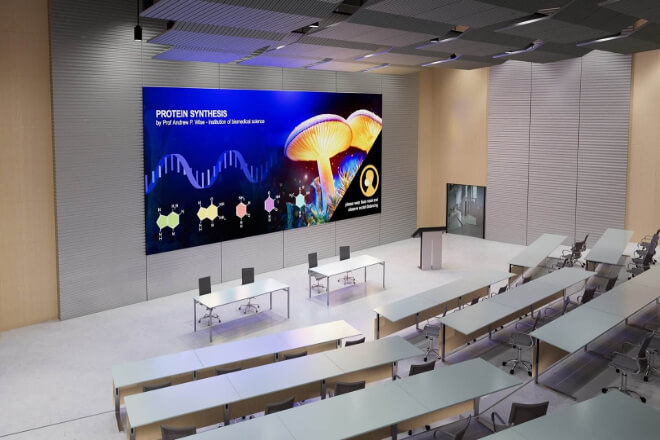
1). High Definition and Visual Experience
The high definition and color reproduction capabilities of LED displays are particularly suitable for educational settings.
1.1). 高 解决:
The resolution of current LED displays is getting higher and higher, with astonishingly clear image details.
For example, when displaying cell structures in biology class or topographic maps in geography class, students can clearly see every small detail, making learning more engaging.
1.2). Color Reproduction Capability:
LED displays have excellent color performance, reproducing very realistic colors. For example, in chemistry experiments, the changes in solution color can be accurately presented.
In art classes, the colors of famous paintings can be perfectly displayed, allowing students to more intuitively experience the charm of color.
2). Large Size and Visual Advantages
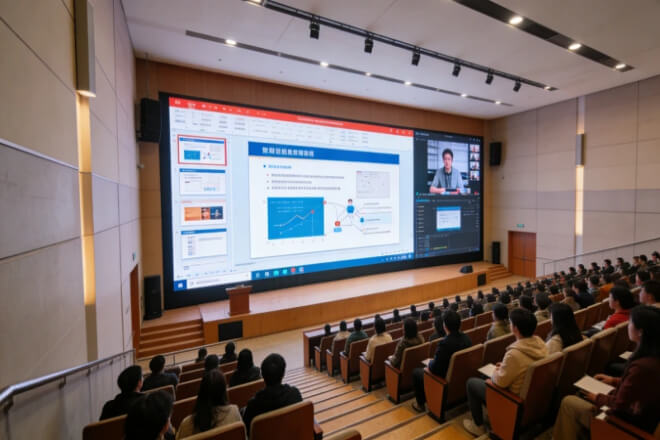
Large-sized LED displays are particularly useful in classrooms, auditoriums, and other places.
2.1). Suitable for Large Spaces:
In places like classrooms or auditoriums, a larger screen means that students sitting in the corners can still see clearly.
Moreover, LED displays have high 亮度, and the image will not be blurry even in bright daylight, making them much better than traditional projectors.
2.2). Richer Content Display:
Large screens can display more content simultaneously, such as comparing several charts, pictures, or videos side-by-side, making it easier for teachers to explain.
Furthermore, these screens can be combined to form even larger screens as needed, meeting the needs of various teaching scenarios.
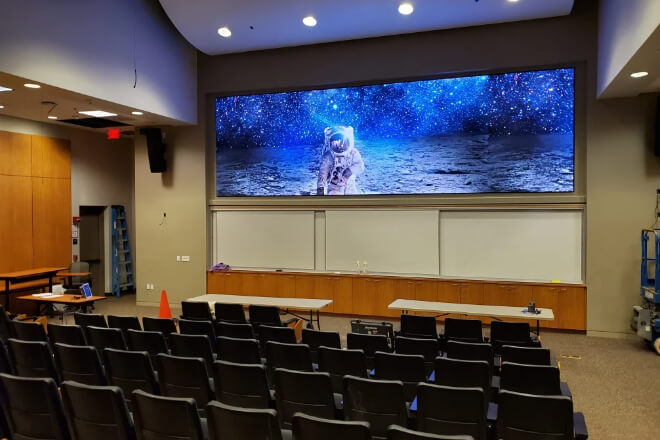
1). Applications in Classroom Teaching
Many schools are now starting to replace old blackboards and projectors with LED displays.
Blackboards are troublesome to clean, and it’s difficult to see complex diagrams clearly; projectors are practically invisible in bright classrooms, and prolonged use can strain the eyes.
LED displays are different; they have high 亮度 and clear images, so they can be seen clearly no matter how bright the classroom is.
Moreover, it can split the screen, allowing teachers to write formulas on one side and display animations on the other, enriching the teaching content significantly.
In multimedia teaching, LED displays are even more powerful. For example, in experimental classes, teachers can use it to play real-time videos of experimental operations.
Display experimental data synchronously, and even simulate some dangerous experiments.
For biology classes, it can even display 3D models of human organs, allowing students to examine them from various angles, making learning much easier.
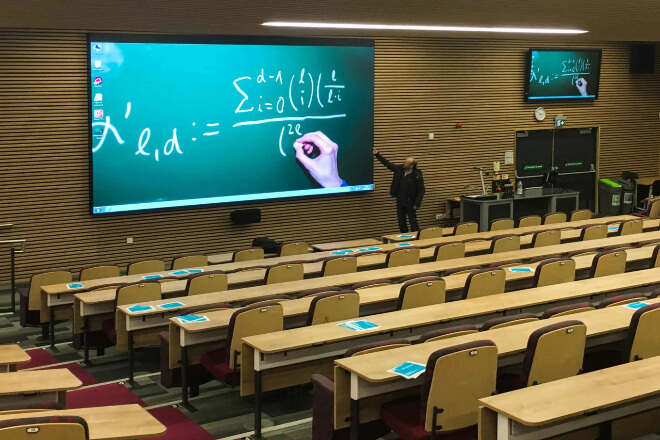
2). Distance Education and Online Courses
In distance education and online courses, LED displays have been a great help.
Its smooth and clear picture allows students to clearly see the teacher’s explanations and course materials even when studying at home.
Furthermore, its excellent color reproduction and realistic images make students feel as if they are sitting in a classroom.
More importantly, LED displays support video conferencing, allowing students to interact with teachers and classmates in real time, making questions and discussions much easier.
This sense of interaction makes distance learning less tedious and motivates students to learn more.
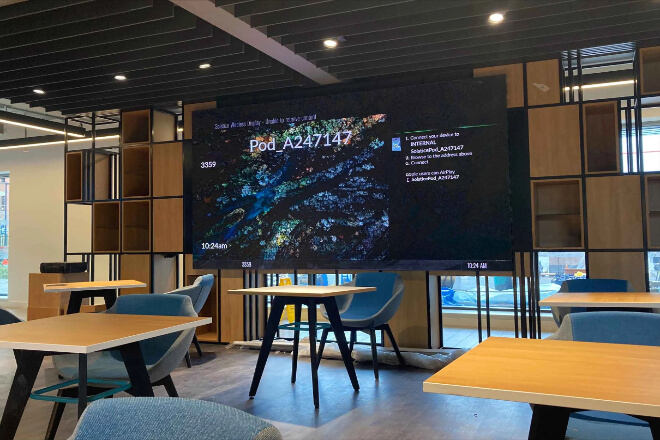
3). Campus Information Dissemination and Promotion
In schools, LED displays have also become a great tool for disseminating information.
LED displays are installed at the school entrance, library, and teaching buildings to display campus announcements, event previews, competition results, and more.
For example, the display at the school entrance can scroll through the latest school news, allowing teachers and students to stay informed about important school events.
The display in the library can showcase the latest academic research, attracting teachers and students to browse.
The dynamic images of LED displays are particularly attractive, and the content can be updated in real time, unlike traditional banners and posters that need to be replaced when they are outdated.
This greatly improves the efficiency of campus information dissemination, allowing everyone to get the information they need in a timely manner.

1) Initial Investment and Maintenance Costs
Let’s talk about the cost of buying and installing LED displays. Initially, they are quite expensive.
Buying a decent LED display, plus installation costs, can easily run into hundreds of thousands of yuan.
Compared to traditional projectors and electronic whiteboards, the price is significantly higher. However, while traditional equipment is cheaper, its functionality is limited and not as user-friendly.
Now let’s look at the operating costs. The advantage of LED displays is that they are easy to use, require simple maintenance.
And have a long lifespan unlike projectors, which require frequent bulb replacements, which is troublesome and expensive.
LED displays typically last for several years without major problems, requiring only minor annual maintenance. Overall, the maintenance costs are quite low.
2) Long-Term Benefits and Return on Investment
Although the initial investment is high, LED displays offer numerous benefits in the long run.
In the classroom, they can display ultra-high-definition images with vibrant colors, allowing students to see everything clearly and significantly increasing their learning interest.
For example, in history class, displaying details of ancient architecture, or in biology class, showing cell structures, allows students to see more details, naturally leading to better learning outcomes.
Moreover, installing these high-tech display screens would make the school look particularly modern, significantly enhancing its image.
For example, when parents visit the school and see such advanced equipment in the classrooms, they will undoubtedly be impressed, giving the school a significant advantage in student recruitment.
In the long run, although the initial investment is substantial, LED displays are durable, energy-efficient, and have low maintenance costs.
They can improve teaching quality and attract more students and parents. These indirect benefits, when combined, make it a very worthwhile investment.
 English
  Español
  简体中文
简体中文  Français
  日本語
日本語  한국어
한국어  العربية