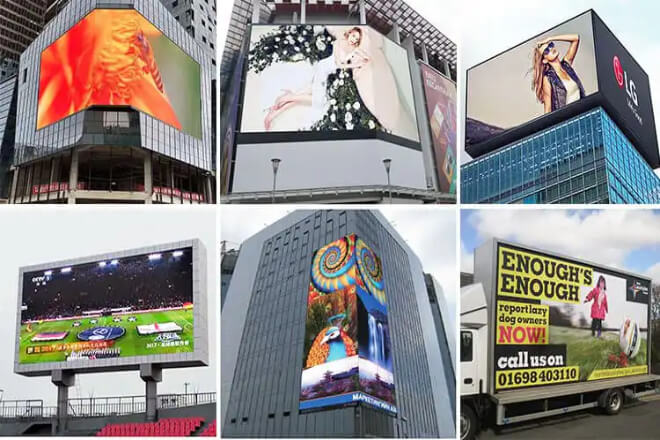
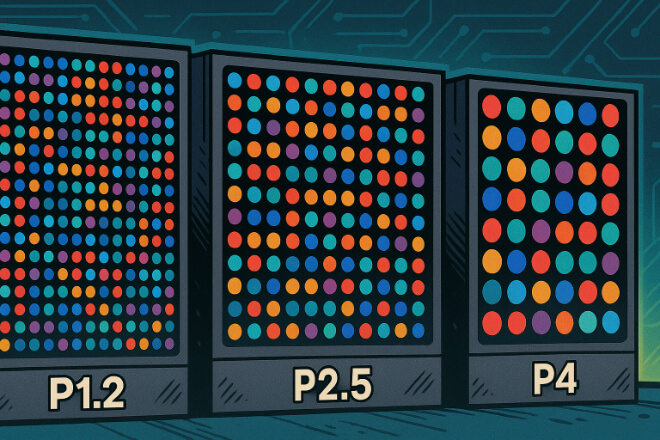
LED Display Technology Comparison: P1.2 vs P2.5 vs P4

介绍

当选择一个 LED显示屏, it’s not just about screen size or price; more importantly, consider the P-value (像素间距) and its impact on the image quality and the usage environment.

This article compares P1.2, P2.5, and P4 screens, examining their performance, installation and maintenance requirements in different environments.

As well as their respective advantages and disadvantages, to help you choose the most suitable LED screen.

目录

1. What is the "P" value of an LED display?

In the LED display industry, the “P-value” is a crucial parameter. It refers to the 像素间距, which is the distance between the centers of two adjacent pixels on the screen, usually measured in millimeters (mm).

The smaller the number, the denser the pixels, resulting in a more detailed image; the larger the number, the sparser the pixels, making the display more suitable for viewing at a distance.

For example, a P2 screen indicates a 2mm pixel pitch, suitable for close-up viewing in conference rooms or exhibition halls.

While a P6 screen has a 6mm pixel pitch, it is more suitable for outdoor billboards or large plazas.

1). The Role of P-Value

1.1) Determining Clarity

The smaller the P-value, the more pixels per square meter, resulting in a more detailed image.

For displaying text, charts, or high-definition images, a small P-value screen can present more detail, and even at close range, there is no noticeable graininess.

1.2) Impacting Viewing Experience

Small-pitch screens are suitable for close-range viewing, such as in office conference rooms, exhibitions, and command centers.

Large-pitch screens are suitable for long-distance viewing, such as outdoor advertising and large concert backdrops.

Choosing the appropriate P-value allows viewers to obtain the best visual experience.

1.3) Impacting Cost and Manufacturing Process

The smaller the P-value, the higher the requirements for LED chips, welding precision, and lamp bead consistency, naturally leading to higher costs.

For example, a P1.5 screen may cost several times more than a P4 screen; therefore, budget and cost-effectiveness should be considered when choosing.

1.4) Determining Usage Scenarios

Choosing the appropriate P-value based on the screen’s usage environment and viewing distance can balance image quality and cost.

For high-precision indoor displays, choose a small P-value; for long-distance outdoor displays, choose a large P-value.

This ensures both quality and avoids wasting investment.

2) The Relationship Between P-Value and Pixel Pitch

In essence, “P-value” and “pixel pitch” are the same concept, just different names.

P-value emphasizes product specifications, such as P2, P3, and P4.

Pixel pitch emphasizes physical distance, such as 3mm, 2.5mm, etc.

Their relationship is very direct:

  • P3 = 3mm pixel pitch

  • 2 = 1.2mm pixel pitch

Therefore, the P-value you see when selecting a screen tells you how dense the pixels are and how clear the image will be.
2. Features and Applications of P1.2 LED Displays

1) 解决 and Display Effect of P1.2

The most attractive feature of P1.2 LED displays is their ultra-high-definition image.

Here, “P1.2” refers to a pixel pitch of only 1.2 millimeters, meaning the distance between each pair of LED beads is extremely small.

This means that thousands of LEDs can be packed into a single area, resulting in a completely grain-free image even at close range, with astonishingly clear details.

For example, if you stop to look at a product advertisement on a display screen in a high-end retail store, the P1.2 screen can display small text and complex charts.

And even dynamic videos with exceptional clarity, and the color gradients are natural, without blurring or jagged edges.

Compared to P2 or P2.5 screens, the P1.2 has a significant advantage in detail presentation, making it particularly suitable for scenarios requiring close-up viewing and high-definition display.

It can be said that its display effect is almost comparable to LCD or OLED screens, giving you the feeling of “seeing closer and seeing more clearly.”

2). Applicable Scenarios

The P1.2 screen is suitable for scenarios requiring close-up viewing and high-precision display, almost exclusively those places with high image quality requirements:

In luxury boutiques or brand flagship stores, the P1.2 screen can display product textures, color schemes, and dynamic effects.

Allowing customers to experience the exquisite details and brand value of the products up close.

Imagine a customer walking up to a shop window, where the product displays on the screen are so clear and detailed that you can see every single button—the visual impact is incredibly strong.

博物馆, science centers, and various exhibitions, P1.2 screens can display high-解决 images, interactive content, or real-time data, providing visitors with an immersive experience.

For example, in science museums displaying the microscopic world or astronomical star charts, the high resolution and rich detail allow viewers to fully understand every complex graphic and dynamic change.

购物广场, 酒店 lobbies, and conference rooms, P1.2 screens can display advertisements or information with exceptional clarity.

Even at close range, it enhances the visual experience and information delivery, encouraging customers to stay longer.

These scenarios demand extremely high information accuracy. P1.2 screens can display high-definition data, dynamic charts, and monitoring footage.

Ensuring that staff can quickly and accurately read every piece of information at close range improves decision-making efficiency.

In short, if you want viewers to be able to see details even when they are very close to the screen, a P1.2 screen is almost always the most suitable choice.

3). Advantages and Limitations of P1.2

3.1).优点:

  • High definition and detail: Almost no graininess when viewed at close range; small fonts, charts, and videos are all clear.

  • 良好的色彩表现: Natural gradations and rich image details, suitable for high-end displays.

  • Enhanced brand experience: Whether in shopping malls, exhibitions, or conference rooms, high-definition images give viewers a sense of professionalism and quality.

3.2). Limitations:

  • 成本较高:

High pixel density means higher material and production costs than ordinary P2 and P2.5 screens, so the budget must be considered when choosing.

  • Limited viewing distance:

P1.2 screens are mainly suitable for close-range viewing. If viewers are too far away, their advantages will be diminished, and the return on investment may not be obvious.

  • High maintenance requirements:

High pixel density means more sophisticated installation and maintenance, requiring regular maintenance by professionals to ensure long-term screen stability.

3. Characteristics and Applications of P2.5 LED Displays

1). P2.5 解决 and Display Effect

The pixel pitch of a P2.5 LED display is 2.5 mm, meaning the distance between every two LEDs on the screen is slightly larger than that of a P1.2 display, but it is still considered a high-definition small-pitch screen.

This pixel density means that at medium viewing distances, the screen image remains very clear, displaying text, images, and videos with great detail.

Compared to a P1.2 screen, if you are very close to the screen (e.g., less than 2 meters), you might see a slight graininess on a P2.5 screen.

But once the viewing distance exceeds 2-3 meters, this difference is almost imperceptible.

Therefore, the P2.5 screen offers significantly lower cost than the P1.2 screen while maintaining image quality, making it a practical choice that balances clarity and budget.

In short, if you don’t need an ultra-high-definition display at close range, a P2.5 screen is perfectly adequate, and the image quality remains very comfortable and natural.

2). Applicable Scenarios

P2.5 LED displays are suitable for indoor environments with medium viewing distances and have a wide range of applications. Typical scenarios include:

In corporate conference rooms or multi-functional halls, P2.5 screens allow every participant to clearly see PPT content and dynamic charts.

Or text descriptions, ensuring no detail is missed, regardless of whether they are seated in the front or middle row.

In shopping malls, P2.5 screens are ideal for displaying videos or animations, providing clarity and attracting attention.

And at a lower cost than P1.2 screens, making them suitable for large-scale deployments.

Imagine customers entering a shopping mall and being drawn to dynamic promotional ads on the screens, increasing exposure without exceeding the budget.

In corporate lobbies, showrooms, or corporate culture walls, P2.5 screens can display brand promotions, real-time data, or welcome messages.

The screen’s clear image and natural colors provide visitors with a professional and sophisticated visual experience.

In training classrooms or educational demonstration areas, P2.5 screens can display text, charts, and video content, ensuring clarity even at medium viewing distances.

At the same time, the cost is not as high as P1.2 screens, making them suitable for small to medium-sized training venues.

In short, P2.5 screens offer high-definition images at a more affordable price than ultra-fine pitch screens, making them suitable for most indoor medium-distance viewing environments.

3). Advantages and Limitations of P2.5

3.1).优点:

  • Clear Image:

At medium viewing distances, text, images, and videos are all very detailed, and there is no eye strain even after prolonged viewing.

  • High Cost-Effectiveness:

The cost is much lower than P1.2, making it suitable for scenarios with limited budgets but requiring high-definition performance.

  • Wide Range of Applications:

Whether in conference rooms, shopping malls, corporate demonstration areas, or training classrooms, P2.5 screens are versatile and can handle most situations.

3.2). Limitations:

  • Slight Graininess at Close Distance:

If the audience is very close to the screen, such as less than 2 meters, small fonts or details may not appear sharp enough.

  • Slight limitations in high-resolution display:

For extremely detailed charts, tiny text, or high-definition images displayed at close range, a P2.5 screen may not be able to fully display every detail.

  • Maintenance still requires attention:

Although the pixel density is lower than P1.2, the screen still requires professional installation and maintenance to ensure long-term stable operation.

4. Characteristics and Applications of P4 LED Displays

1). P4 Resolution and Display Effect

The pixel pitch of a P4 LED display is 4 mm, meaning the pixel density is slightly lower than P2.5 and P1.2.

Therefore, when viewed at close range, the image may appear slightly grainy, and small text or complex charts may not be sharp enough.

However, as long as you maintain a certain distance from the screen—approximately 4 meters or more—the image will be very clear, and text and video content will be easily understandable.

The resolution of a P4 screen is sufficient to display large images, video advertisements, or dynamic information.

Its brightness is also high; even in bright outdoor environments, the image remains clearly visible, making it ideal for viewing from a distance.

It can be understood that a P4 screen emphasizes the visual effect from a distance, rather than viewing fine details up close.

2) Applicable Scenarios

P4 LED displays are best suited for medium to long-distance viewing and large-space applications. Common scenarios include:

In basketball courts, football fields, or multi-purpose stadiums, P4 screens can be used to display scores, match information, and advertising content.

Even spectators sitting in the back rows can clearly see the content on the screen, ensuring smooth information delivery.

Large advertising screens on city streets, roadsides, or building facades can play dynamic advertisements or promotional videos.

Or promotional information, attracting the attention of passersby and vehicles from a distance, resulting in excellent exposure.

In commercial plazas, city squares, or large event venues, P4 screens can play promotional materials for festivals and live sports broadcasts.

Or public information, ensuring that viewers at a distance can clearly see the content.

在大规模 阶段 events, P4 screens are commonly used as background screens to play videos, special effects, and live feeds.

Viewers at a distance can also experience the impact of the visuals.

In general, P4 screens are ideal for large spaces and long-distance viewing environments, especially outdoors or in crowded venues.

3). Advantages and Limitations of P4

3.1).优点:

  • Clear viewing at a distance:

Large pixel pitch ensures clear and easily legible content even from a distance, suitable for squares, stadiums, and outdoor advertising.

  • High cost-effectiveness:

More affordable than small-pitch screens, resulting in lower installation costs for large areas, making it particularly suitable for outdoor or large-screen applications.

Sufficient screen brightness maintains visibility even in direct sunlight outdoors, while covering a larger viewing area.

3.2). Limitations:

  • Limited close-range viewing:

When too close to the screen, text and details may appear grainy, unsuitable for detailed displays.

  • Lower resolution than small-pitch screens:

For scenarios requiring the display of high-definition images, small fonts, or detailed charts, P4 screens cannot fully meet the requirements.

  • Installation and maintenance still require expertise:

Outdoor screens, in particular, have high requirements for waterproofing, dustproofing, and sun protection, requiring professional installation and regular maintenance.

5. Relationship between Resolution and Viewing Distance: How to Choose the Appropriate P-Value?

1) Display Effects of Different P-Values at Different Viewing Distances

The P-value of an LED display screen is essentially the pixel pitch between two pixels on the screen.

The smaller the pixel pitch, the finer the image and the more suitable it is for close-up viewing.

1.1) P1.2 Screen

The pixel pitch of a P1.2 screen is only 1.2 mm, which is very dense, resulting in exceptionally clear images that are not grainy even at close range.

Whether it’s text, charts, or dynamic images, it can present rich details and natural gradations.

Screens like this are ideal for high-end retail stores, conference rooms, or exhibitions.

Viewers can carefully examine the screen content from a distance of 1-2 meters, and even small fonts and fine patterns are clearly visible.

1.2) P2.5 Screen

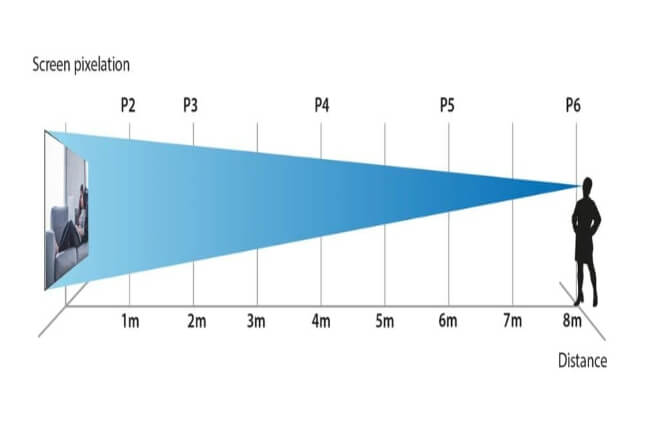
The pixel pitch of a P2.5 screen is 2.5 mm. While the clarity is slightly lower than P1.2, it still performs well at medium viewing distances (approximately 2-4 meters).

For shopping mall advertising screens, corporate conference rooms, or training classrooms, P2.5 screens offer a good balance of clarity and cost compared to P1.2 screens, providing a more affordable option.

Upon close viewing, there might be a slight graininess, but this is generally not a major concern for most viewers.

1.3). P4 Screens

P4 screens have a pixel pitch of 4mm, making them more suitable for viewing from a distance, typically 4 meters or more.

They perform excellently in stadiums, plazas, large billboards, or stage backdrops, ensuring clear visibility of text, images, and videos even from a considerable distance.

However, if viewed too closely, text and details may appear slightly grainy, making them unsuitable for close-up viewing.

In general, a smaller P-value is better for close-up viewing, while a larger P-value is better for long-distance viewing.

Choosing the appropriate P-value hinges on understanding the viewer’s distance, ensuring a clear screen without compromising cost.

2) How to Choose the Appropriate P-Value Based on Viewing Distance

A simple empirical formula can be used as a reference for choosing the P-value:

Optimal Viewing Distance (meters) ≈ P-value (millimeters) × 1~1.5 meters

例如:

  • 2 screen → Suitable for viewing at 1~1.8 meters

  • 5 screen → Suitable for viewing at 2.5~3.7 meters

  • P4 screen → Suitable for viewing at 4~6 meters

This formula is only a reference; the actual selection should also consider the screen size and the number of viewers.

If the audience will be very close, choose a screen with a smaller P-value.

If most viewers are watching from a distance, a screen with a larger P-value is sufficient, ensuring clarity while saving costs.

3) Other Factors Affecting the Viewing Experience

Besides the P-value and viewing distance, some other factors affect the visual effect:

3.1) Ambient Light

The light around the screen affects the display effect. When exposed to direct sunlight outdoors, higher brightness is needed to ensure clear visibility.

When indoor lighting is soft, the brightness requirement is relatively lower.

3.2) Screen Size

The larger the screen, the clearer it is, even when viewed from a distance, even with a slightly higher P-value.

Larger screens attract more attention, but if the screen is too small, viewers at a distance may not be able to see details clearly.

3.3) Content Type

Displaying text, charts, or detailed images requires a smaller P-value to ensure clarity.

Playing videos or simple motion graphics can have a lower P-value requirement.

3.4) Viewing Angle

The viewing angle of an LED screen affects image visibility.

Wide-viewing-angle screens ensure that viewers in different positions can see a clear image, making them particularly suitable for shopping malls, plazas, or large conference venues.
6. Brightness and Contrast Ratio: Comparison of P1.2 vs P2.5 vs P4

Pitch (P Value) Typical Use Cases Purchase Cost Installation Cost Maintenance Cost Long-term Operation Overall Evaluation
P1.2 Exhibitions, high-end retail, conference rooms 高的 High (requires high-precision installation) High (requires detailed maintenance) Highest image quality, best for close-range viewing, enhances brand image Ideal for high-end applications, but budget pressure is high
P2.5 Mall advertising, corporate offices, training rooms Medium Medium Medium Clear image quality, good balance of performance and cost, suitable for medium viewing distances High cost-performance ratio, suitable for most indoor scenarios
P4 Sports venues, public squares, large billboards, stage backgrounds 低的 Low (installation is easier) Low (simple maintenance) Good visibility from long distances, low cost, suitable for large-area installations Economical choice, ideal for long-distance or large-screen applications

1) Why are Brightness and Contrast Ratio Important?

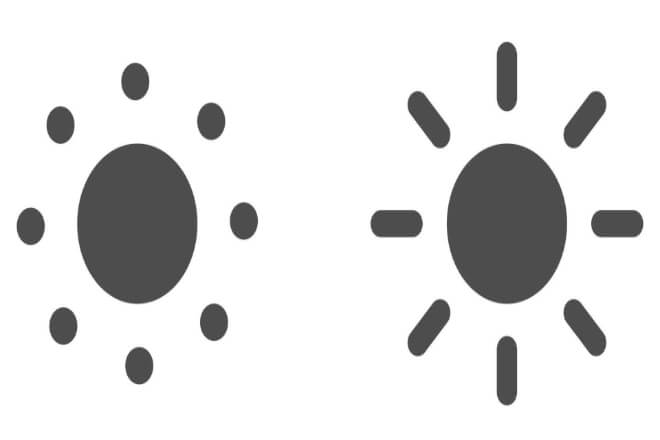
Brightness and contrast ratio are two key factors affecting the viewing experience of LED displays.

1.1) Brightness

Determines whether you can “see clearly.” Insufficient brightness results in a dim image, making it difficult to see text or motion images.

Excessive brightness, especially when viewed at close range indoors, can be glaring and even cause dizziness.

1.2) Contrast Ratio

Determines how three-dimensional and vivid the image appears. High contrast results in sharp blacks and whites, rich color gradations.

And clear details; low contrast produces a flat image, easily loses detail, and looks “hazy.”

You can understand it this way: brightness is “whether you can see it,” while contrast is “how well it looks.” A good balance of both produces a clear and comfortable image.

2) How to Choose Brightness Brightness requirements vary depending on the environment:

2.1) 室内LED显示屏

For example, in conference rooms, shopping malls, exhibition halls, or office lobbies, he lighting is soft, and the screen doesn’t need to be particularly bright.

Usually, 800-1000 nits is sufficient; too much brightness can be glaring, causing eye strain over time and wasting electricity.

2.2) 户外LED显示屏

Outdoor LED screens are exposed to direct sunlight, so the screen must be bright enough to clearly display content.

Generally, 4500-6000 nits is recommended, and some very large outdoor advertising screens may require even higher brightness.

At the same time, outdoor screens must also consider anti-glare, waterproof, and dustproof features to ensure all-weather usability.

3) Performance of P1.2, P2.5, and P4 Screens in Brightness and Contrast

3.1) P1.2 Screen:

Small pixel pitch, primarily for indoor close-range viewing.

Brightness is typically 400-800 nits, sufficient for clarity. High contrast, text, charts, and details are rendered very finely.

Excellent for exhibitions, conference rooms, or high-end retail stores. Excessive brightness can be glaring and unsuitable for close-range viewing.

3.2) P2.5 Screen:

Slightly larger pixel pitch, suitable for medium-distance viewing, brightness is generally around 500-1000 nits. Good contrast, natural colors, and clear image layering.

Whether for shopping mall advertising, corporate displays, or training classrooms, P2.5 screens ensure a clear and comfortable viewing experience, while being less expensive than P1.2 screens.

3.3) P4 Screen:

Larger pixel pitch, more suitable for long-distance and outdoor use. High brightness is required, generally 2000-5000 nits, ensuring visibility even in sunlight.

With moderate contrast, the image detail is not as fine as that of small-pitch screens, but it still has a strong visual impact at a distance.

It is very suitable for stadiums, large billboards, squares, and stage backdrops.

In summary, the smaller the P-value, the more suitable the screen is for close-range fine display, requiring less brightness but better contrast.

The larger the P-value, the more suitable the screen is for medium- to long-distance and outdoor display, requiring higher brightness to ensure visibility.

7. Cost Comparison of P1.2, P2.5, and P4

Pitch (P Value) Typical Use Cases Purchase Cost Installation Cost Maintenance Cost Long-term Operation Overall Evaluation
P1.2 Exhibitions, high-end retail, conference rooms 高的 High (requires high-precision installation) High (requires detailed maintenance) Highest image quality, best for close-range viewing, enhances brand image Ideal for high-end applications, but budget pressure is high
P2.5 Mall advertising, corporate offices, training rooms Medium Medium Medium Clear image quality, good balance of performance and cost, suitable for medium viewing distances High cost-performance ratio, suitable for most indoor scenarios
P4 Sports venues, public squares, large billboards, stage backgrounds 低的 Low (installation is easier) Low (simple maintenance) Good visibility from long distances, low cost, suitable for large-area installations Economical choice, ideal for long-distance or large-screen applications

1) Price Difference Analysis

The price difference of LED displays with different P-values mainly lies in the procurement cost, installation cost, and maintenance cost.

1.1). Procurement Cost

P1.2 screens are ultra-small pitch high-definition screens with very high pixel density, requiring more LED beads and a more complex driving system, hence the highest price.

P2.5 screens have moderate pixel density and are significantly cheaper than P1.2, suitable for companies with limited budgets but still seeking high-definition displays.

P4 screens have a large pixel pitch, resulting in the lowest manufacturing and material costs, making them an economical choice for large-area, long-distance displays.

1.2). Installation Costs

Small-pitch LED screens require high installation precision, necessitating a more professional installation team and more time, making P1.2 screens the most expensive to install.

P2.5 screens are relatively easy to install with moderate costs; P4 screens have lower installation precision requirements, shorter construction cycles, and the lowest installation costs.

1.3) Maintenance Costs

Small-pitch LED screens require more meticulous maintenance, especially P1.2 screens used indoors for extended periods at high brightness, resulting in higher maintenance costs.

P2.5 screens have moderate maintenance difficulty, while P4 screens have a simple structure and the lowest daily maintenance costs.

2) Impact of Different P-Values on Corporate Budgets

Different P-value LED screens significantly impact corporate budgets:

2.1) P1.2 Screens

Suitable for high-end applications, requiring substantial investment from companies.

Although the initial investment is high, it delivers the finest image quality, making it ideal for 展览, conference rooms, and high-end retail stores.

Companies need to consider the overall costs of procurement, installation, and daily maintenance.

2.2) P2.5 Screens

A more cost-effective option, ensuring high-definition display at medium distances without being as expensive as P1.2 screens.

Suitable for medium-sized conference rooms, shopping mall advertising, corporate offices, or training classrooms, it is a common choice for companies with limited budgets but high image quality.

2.3). P4 Screen

Low initial investment, suitable for large-area deployment and long-distance viewing scenarios, such as 体育馆, squares, billboards, and 阶段 backdrops.

While its detail is not as good as small-pitch screens, it puts less pressure on the company’s budget, making it a cost-effective large-screen solution.

3) Total Cost Analysis: Balancing Initial Investment and Long-Term Operation

When choosing an LED screen, it’s important to consider not only the initial purchase price but also long-term operating costs:

3.1). P1.2 Screen

High initial investment, but if used for close-range displays or high-end scenarios, it can significantly enhance brand image and customer experience, resulting in high long-term value.

Maintenance and electricity costs are slightly higher, requiring a sufficient budget.

3.2). P2.5 Screen

Moderate initial investment and long-term operating costs, suitable for companies seeking cost-effectiveness while ensuring image quality and user experience. For most companies, the P2.5 screen is a relatively safe choice.

3.3). P4 screens

P4 screens have low initial investment and low maintenance costs, making them suitable for large-scale applications, but their close-range detail display capabilities are limited.

For long-distance viewing or outdoor environments, P4 screens maximize budget efficiency.

Simply put, choosing the P-value is a trade-off between image quality and cost, initial investment and long-term operation.

Businesses can choose flexibly based on usage scenarios, viewing distances, and budgets to ensure a reasonable and efficient investment.

8. Performance Comparison of P1.2, P2.5, and P4 in Different Environments

1) Suitable Environments for Each

Each P-value LED screen represents a different “ideal viewing distance,” determining its most suitable environment.

1.1) P1.2 Screens:

These screens have extremely dense pixels, making them ideal for indoor close-range viewing.

For example, in exhibition halls, high-end retail stores, conference rooms, or offices, viewers can see every detail of text and images even when only a few meters or steps away.

The colors are vibrant and detailed, but the light requirements are moderate.

Direct sunlight may make them appear dim or glaring, making them less suitable for outdoor use.

1.2) P2.5 Screen

The P2.5 screen falls between small-pitch and large-pitch screens, suitable for medium-distance indoor environments.

It can be used in shopping mall advertising, corporate conference rooms, and training classrooms.

It has slightly higher brightness, sufficient for ordinary indoor lighting or natural light near windows, but direct sunlight outdoors is not recommended.

Its image clarity is good, the overall visual experience is comfortable, and the cost is significantly lower than P1.2.

1.3). P4 Screen

The P4 screen has a larger pixel pitch, making it more suitable for long-distance viewing or outdoor environments.

Stadiums, squares, large billboards, or stage backdrops are its main applications.

It has very high brightness, making it clearly visible even in sunlight. However, if you stand very close to the screen, you will find that the details are not as fine as those of small-pitch screens, and the graininess is noticeable.

However, the large size and high brightness allow viewers at a distance to easily see the image.

2). Installation and Maintenance Requirements

The difficulty of installation and maintenance varies greatly depending on the P-value of the screen:

2.1). P1.2 Screen

High installation precision is required; the screen must be flat and the pixels aligned, otherwise flaws will be visible upon close inspection.

Long debugging time and maintenance requiring a professional team, with frequent checks of LEDs and driver modules.

High cost, but excellent image quality, giving it a very high-end look.

2.2). P2.5 screen:

Moderate installation requirements, less demanding on precision than P1.2. Relatively simple maintenance, occasional cleaning and module checks are sufficient.

High cost-performance ratio, making it the first choice for many enterprises.

2.3). P4 screen:

Low installation precision requirements, short construction cycle, suitable for large-area deployment.

Simple maintenance, especially suitable for outdoor large screens.

Daily cleaning and occasional module replacement are sufficient, resulting in low long-term costs.

3) Advantages and Disadvantages in Practical Use

Pitch (P Value) 优点 缺点
P1.2 Ultra-fine image quality, perfect for close-range viewing;
High color fidelity, rich details;
Enhances brand image and high-end presentation.
High cost (purchase, installation, maintenance);
Not suitable for outdoor direct sunlight;
Requires high-precision installation and professional maintenance.
P2.5 Clear image quality at medium viewing distance;
Good cost-performance ratio;
Moderate installation and maintenance requirements.
Slightly less detailed for close-range viewing;
Performance under strong outdoor light is average;
High-end visual effects not as good as P1.2.
P4 Suitable for long-distance and outdoor use;
High brightness and strong visual impact;
Low installation and maintenance costs.
Noticeable pixelation at close range;
Less detailed than smaller-pitch screens;
Color depth and contrast slightly lower.

9. 结论

Overall, P1.2 is suitable for high-end indoor close-range displays, offering the best image quality but at a high cost; P2.5 is suitable for medium-distance indoor applications, offering clarity and high cost-performance.

P4 is suitable for long-distance or outdoor large screens, offering high brightness and convenient installation and maintenance, but limited detail at close range.

When choosing, consider viewing distance, lighting environment, and budget to ensure the screen is both aesthetically pleasing and practical.

Hopefully, this comparison will help you better understand the characteristics of different P-value LED displays, making your screen purchase easier.

Finally, if you would like to learn more about LED displays, 请与我们联系。

发表回复

您的邮箱地址不会被公开。 必填项已用 * 注意

让我们现在开始我们的故事吧!

得到 2025 新价格 现在用于LED屏幕