
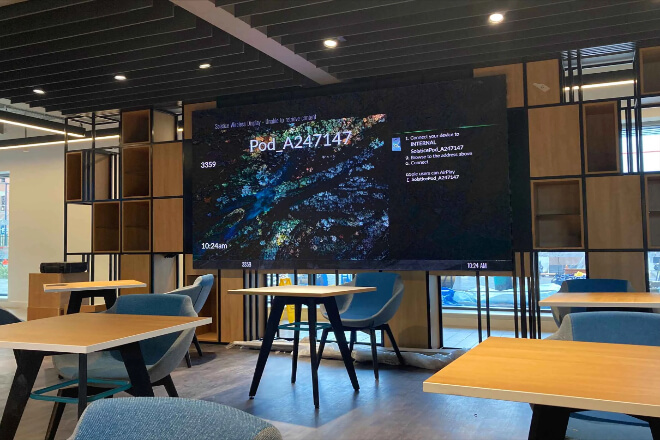
In training meetings with hundreds or even thousands of people, the choice of display device directly affects the efficiency of information transmission.
Compared to traditional projection methods, LED displays often have advantages in large-scale scenarios.
Firstly, in terms of viewing from a distance, projection is easily limited in terms of 亮度 and clarity, especially in spaces with strong ambient light, where the image can easily become unclear.
LED displays, with their higher brightness and better visibility, allow participants in different positions to clearly see the content.
Secondly, large-sized splicing screens can provide a more uniform and stable display effect, less prone to uneven brightness or image degradation.
This is more reliable for scenarios that require displaying training content for extended periods.
Furthermore, in terms of content presentation, LED displays are better suited for displaying charts, videos, and dynamic demonstrations.
Helping to enhance the intuitiveness of information delivery and thus making the training process more efficient.
Simply put, in large-scale training scenarios, LED displays not only solve the problem of “not being able to see clearly,” but also improve the overall training experience and efficiency to a certain extent.
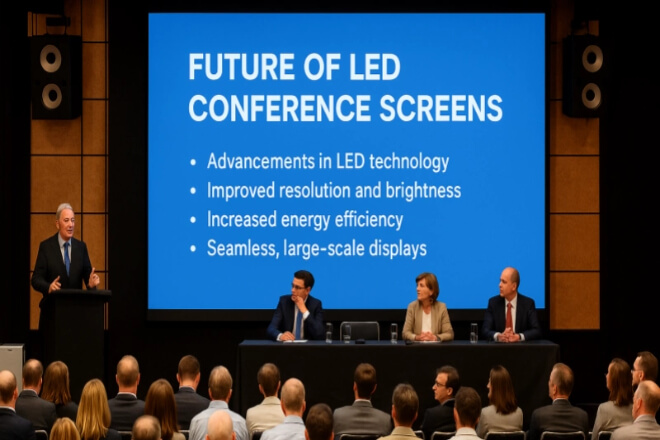
Whether to choose an LED display largely depends on the conditions of the space itself, rather than simply the quality of the equipment itself.
In spaces like large conference rooms or auditoriums, due to the large area and long viewing distance.
LED displays are generally more suitable for ensuring overall clarity and visibility, allowing viewers in different positions to have a consistent viewing experience.
In contrast, in some smaller meeting rooms, projectors or video conferencing systems are often sufficient, and they also have advantages in terms of cost and deployment flexibility.
These types of spaces do not necessarily need a higher-configuration solution like LED displays; the key is to be “sufficient and appropriate.”
In addition, the lighting environment of the space is also an important factor. If the ambient light in the meeting room is strong, the projected image can be easily affected.
LED displays, however, have an advantage in brightness and can maintain stable display quality under different lighting conditions.
Meanwhile, installation conditions and wall structure also influence the final choice. For example, whether there is sufficient load-bearing capacity.
Whether it is suitable for embedded installation, and whether special structural support is required—all these directly affect the feasibility and cost of the solution.
Simply put, space determines whether an LED display is needed, not whether an LED display is good or not.
In actual selection, considering space conditions first, then usage needs, is often more effective than simply comparing equipment parameters.
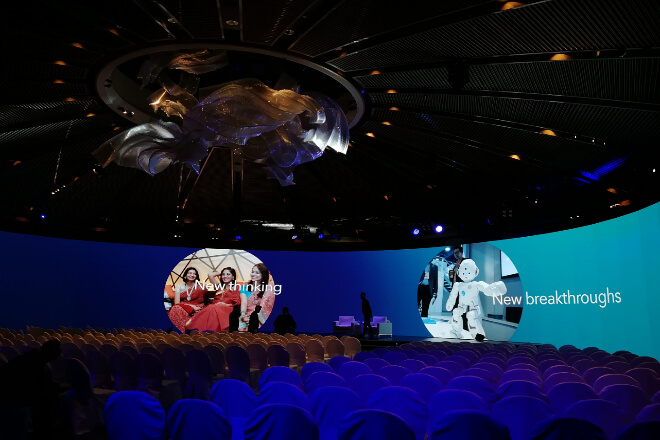
The type of training content directly affects the choice of display equipment and the required effect.
Different forms of content have different focuses regarding clarity, resolution, and display methods.
For example, video and animation content rely more on the smoothness of the image and the overall visual performance.
In this case, LED displays can present dynamic images well, bringing a more coherent and impactful viewing experience, and are more likely to attract attention.
For data, tables, and large amounts of text, clarity is particularly important. Viewers need to quickly grasp information.
If the image is not sharp enough or the font edges are unclear, it can affect comprehension efficiency.
Therefore, this type of content typically requires higher 解决 和 像素间距。
At the same time, the complexity of the content also influences screen selection.
If the content is information-rich and structurally complex, higher resolution and finer display capabilities are needed to ensure readability.
Conversely, if the content is relatively simple, the configuration requirements can be appropriately reduced.
Simply put, not all training content is suitable for the same type of display solution; rather, the display capabilities should be matched to the content type.
When the content and display device are well-matched, information transmission is smoother, and the training effect is more easily amplified.
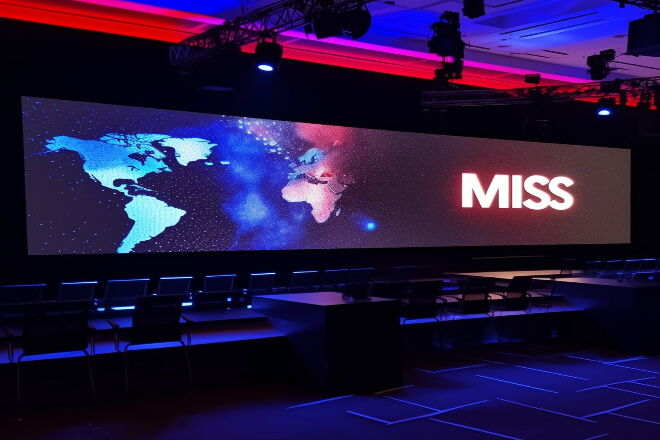
In training scenarios, LED displays often need to be used continuously for several hours, or even a whole day.
Under such usage intensity, the stability of the device becomes particularly critical, not just whether it can display.
First, prolonged operation places higher demands on the screen’s heat dissipation capabilities.
Insufficient heat dissipation design can lead to overheating during continuous operation, affecting display quality and even shortening lifespan.
Therefore, good heat dissipation and a stable structural design are crucial for long-term operation.
第二, 亮度 uniformity and image stability are also important. Uneven brightness, localized color shifts.
Or flickering during use not only affect the viewing experience but can also distract trainees and reduce information delivery efficiency.
Furthermore, the overall reliability of the equipment directly impacts the smooth progress of training.
Failures or malfunctions at critical points can disrupt the training process and potentially affect the overall organizational effectiveness.
Therefore, stability is often more important than mere parameter performance when selecting equipment.
Simply put, in training scenarios with prolonged use, LED displays must not only be “clear to see” but also “stable to use.”
When the equipment can operate stably and continuously, the training process will be smoother, and information delivery will be more efficient.
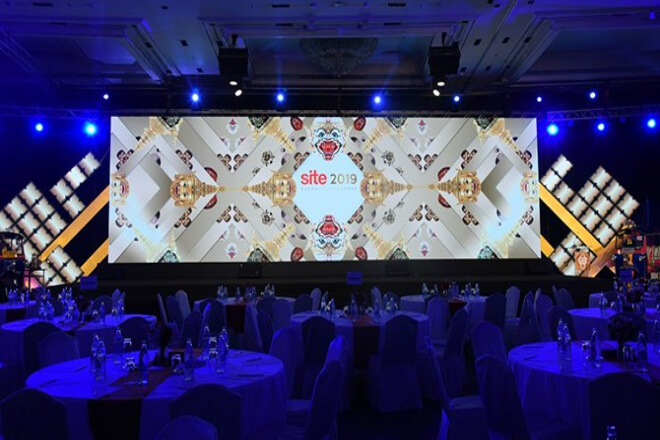
In training scenarios, the cost of LED displays and usage frequency are issues that need to be considered in advance.
Compared to projectors or conventional display devices, LED displays require a relatively higher initial investment, but their advantage lies in their overall cost-effectiveness after long-term stable use.
If a training space is used frequently, such as for daily meetings, regular training sessions, or multiple sessions, the advantages of LED displays will gradually become apparent.
On one hand, they offer more stable performance in brightness, clarity, and stability; on the other hand, maintenance costs are relatively low over long-term use.
Reducing the hidden costs associated with frequent equipment replacement or adjustments.
In contrast, while projectors have a lower initial investment, high-frequency use may require more frequent maintenance.
Such as bulb replacement, image adjustments, or handling ambient light, all of which gradually increase costs over time.
Therefore, the choice of an LED display largely depends on whether the training space is a “long-term, high-frequency” location.
If it’s only used occasionally, the investment may not be worthwhile; however, for spaces with long-term training or high usage frequency, its value will gradually increase.
Simply put, LED displays are more suitable for “high-usage” scenarios than “one-time” scenarios.
When used frequently enough, the initial investment is diluted, resulting in a more reasonable overall return on investment.
 English
  Español
  简体中文
简体中文  Français
  日本語
日本語  한국어
한국어  العربية