
When choosing LED显示屏, many people easily confuse indoor and outdoor screens.
They may look similar, but they are completely different in terms of 亮度, protection, 解决, and installation methods.
To avoid choosing the wrong screen and wasting money, this article will guide you through a simple and clear explanation of the core differences between the two.
1) Different Definitions
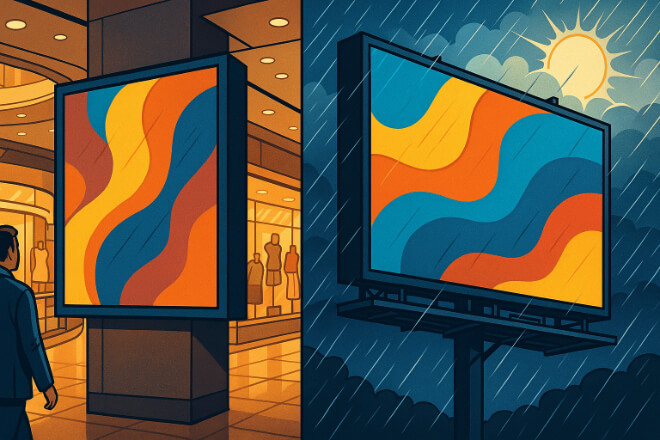
室内LED显示屏 are designed for indoor environments, such as conference rooms, 购物广场, 展览 halls, or offices.
These screens are generally viewed at closer distances and in stable ambient light, so their requirements for 亮度 and protection are not high.
When used to display text, images, or videos, viewers can clearly see every detail, and the experience is comfortable.
户外LED显示屏, on the other hand, are specifically designed for outdoor environments and are commonly found on billboards, large plaza 屏幕, stadiums, or 阶段 backdrops.
These screens need to withstand various weather conditions, such as sunlight, rain, and snow.
And wind, and the 观看距离 is usually much greater, so they have higher requirements for 亮度, protection, and durability.
If an outdoor screen is viewed indoors at close range, the image will appear grainy, while an indoor screen placed outdoors may be difficult to see due to insufficient brightness.
2) Different Technical Requirements
2.1) 亮度
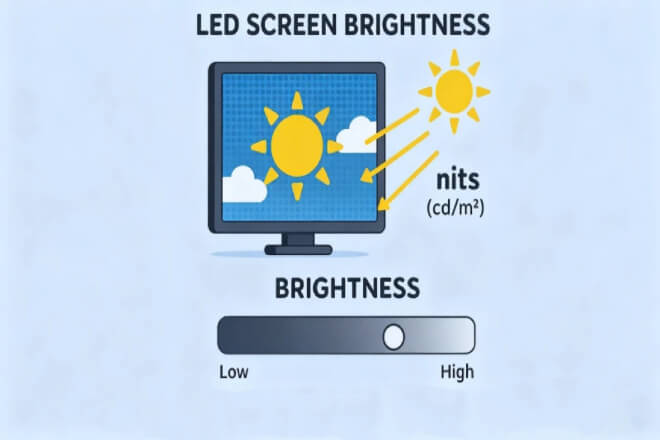
Brightness is a key indicator distinguishing indoor and outdoor screens.
Indoor screens generally only require 400-1000 nits of brightness, and even slightly brighter screens will not be glaring.
In contrast, outdoor screens must have much higher brightness, typically 3500-6000 nits, to ensure clear visibility even in sunlight.
Brightness directly affects the readability and viewing experience of the image.
So it is essential to choose the appropriate brightness based on the usage environment.
2.2) 解决
Indoor screens have a smaller pixel pitch and higher resolution, producing very detailed images.
Text, images, and video details are clearly visible, making them ideal for close-up viewing.
Outdoor screens have a larger pixel pitch and relatively lower resolution, but due to the greater viewing distance.
The visual effect remains clear and natural, allowing viewers at a distance to see the complete image.
2.3) Durability and Protection
Durability and protection are also key differences between the two. Indoor screens don’t require waterproofing or dustproofing.
Their main focus is on heat dissipation and stability, making routine maintenance relatively simple.
Outdoor screens, on the other hand, must be waterproof, dustproof, and lightning-proof.
They must be UV-resistant and must withstand high or low temperatures to ensure stable operation in all weather conditions; otherwise, they are prone to damage.
Furthermore, outdoor screens often require an anti-glare design and automatic brightness adjustment.
Indoor screens prioritize color reproduction and high contrast for a more comfortable close-up viewing experience.
3). Why differentiate between indoor and outdoor screens?
Choosing the right type of screen is crucial.
- First, viewing effect:
If an indoor screen is placed outdoors, the brightness will be insufficient, resulting in a dim image.
If an outdoor screen is brought indoors for close-up viewing, graininess will be noticeable, and text and details will be unclear.
- Second, lifespan:
Outdoor screens must withstand wind, rain, and sunlight.
Otherwise, they are easily damaged. Overly protective indoor screens, while adding to costs, offer no real benefit.
- Finally, cost and budget:
Differentiating between indoor and outdoor screens allows for optimized design and investment based on environmental conditions, ensuring that money is spent wisely.
Indoor LED displays prioritize high definition and detail at a moderate cost; outdoor LED displays prioritize brightness and durability, with investment focused more on protection and brightness.
Simply put, indoor displays emphasize detail and high definition, while outdoor displays prioritize brightness and durability.
Choosing the wrong type can not only affect image quality but also shorten screen lifespan and even increase unnecessary costs.
1). 亮度 Requirements and Typical Application Scenarios for Indoor LED Displays
室内LED显示屏 are typically intended for close-range viewers, so brightness doesn’t need to be exceptionally high; 800-1000 nits is generally sufficient.
Excessive brightness not only wastes electricity but also causes glare and eye discomfort.
Common applications for indoor displays include conference rooms, exhibition halls, high-end retail stores, offices, and training classrooms.
In these environments, the lighting is relatively stable, so as long as the screen ensures clear images and vibrant colors for text and pictures, viewers will have a good viewing experience.
In other words, the brightness of indoor screens is designed for comfortable and clear viewing for those at close range, not for glaring brightness.
2). Brightness Requirements for 户外LED显示屏
Outdoor ambient light varies greatly, especially during the day when direct sunlight can make the screen content almost unreadable if the brightness is insufficient.
Outdoor LED displays typically require a brightness of 4500-6000 nits or even higher to ensure clear visibility even in strong light.
At night, excessive brightness can be glaring and wasteful of electricity. Therefore, many outdoor screens are equipped with automatic brightness adjustment systems that adjust the brightness based on ambient light.
This ensures clear visibility during the day while avoiding glare at night and extends the screen’s lifespan.
Outdoor screens require not only higher brightness than indoor screens but also the ability to intelligently adapt to changes in ambient light—a factor that indoor screens don’t need to consider.
3) How to Choose the Appropriate Brightness Based on the Actual Environment
When selecting brightness, it’s crucial to consider ambient light, viewing distance, and screen type.
If the indoor screen brightness is too high, it not only wastes electricity but may also cause discomfort for viewers.
Conversely, if the brightness is too low, text or video will be difficult to read in bright indoor environments.
Outdoor screens require a greater balance. Insufficient brightness means even a large and expensive screen won’t be clearly visible.
Excessive brightness will be glaring at night and increase energy consumption.
A simple approach is for indoor screens to select brightness based on indoor light intensity and viewing distance, ensuring both clarity and comfort.
Outdoor screens should be selected based on outdoor light intensity, viewing distance, and day/night variations.
Ideally, they should also have automatic brightness adjustment to ensure optimal performance under various lighting conditions.
This avoids wasting costs while providing a good visual experience for viewers.
1) The Impact of 解决 on Display Quality
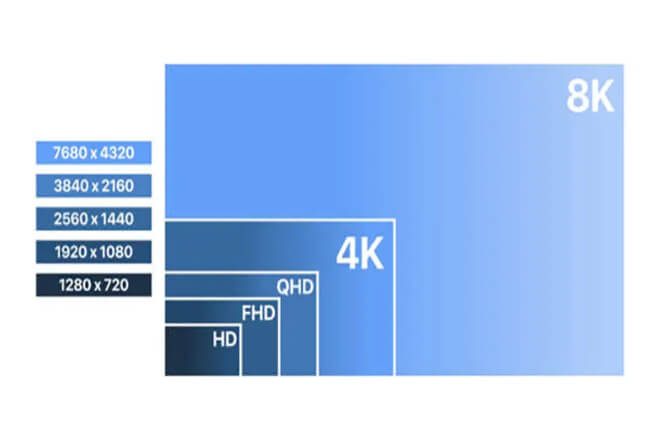
Resolution directly determines the sharpness of the screen image. Higher resolution means denser pixels.
A clearer image, and richer details; lower resolution may result in grainy images and unclear text and images.
Indoor and outdoor needs differ: Indoor screens require higher resolution due to closer viewing distances to ensure clear details and legible text at close range.
Outdoor LED screens offer superior viewing distances. Even with lower resolution, the image remains clear from a distance, and the cost and brightness requirements are more reasonable.
2) Common P-values for Indoor and Outdoor Displays
越小 像素间距 (P-value) of an LED screen, the higher the resolution, making it suitable for close-range viewing.
Common indoor screen P-values include P1.2, P1.5, P2.0, and P2.5. These screens offer great detail and are suitable for exhibition halls, conference rooms, and high-end retail stores.
Outdoor LED screens, due to their longer viewing distances, commonly use larger P-values such as P4, P6, and P8.
These offer high brightness and larger pixel pitch, meeting the needs of long-distance viewing while reducing screen costs and maintenance complexity.
3) The Relationship Between 观看距离 and Resolution
Viewing distance is the most important factor when choosing resolution. Generally, a smaller pixel pitch results in better close-range viewing.
A larger pixel pitch is suitable for long-distance viewing. For example:
P1.2 screen: High pixel density, suitable for viewing at a distance of 1-2 meters;
P2.5 screen: Suitable for distances of 2-4 meters;
P4 screen: Suitable for viewing distances of 4-6 meters or even further.
Simply put, “the closer the screen, the clearer the view, and therefore the smaller the P value needs to be.”
If the screen is too close to the viewer and the P value is too high, the image will appear grainy.
Conversely, using a small-pitch screen for long-distance viewing is both wasteful and unnecessary.
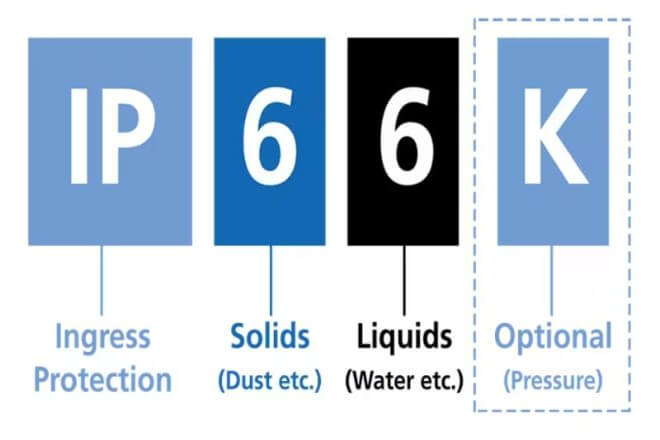
1). Required Protective Characteristics for 户外LED显示屏
Outdoor LED displays must withstand various complex environments, such as rain, dust, wind, and sun exposure.
Some may also encounter snow, frost, or high-temperature exposure.
Therefore, outdoor screens must possess waterproof, dustproof, and windproof characteristics.
Common protection ratings are IP65 or higher, meaning the screen is completely dustproof and can withstand water spray from any direction without ingress.
In addition, outdoor LED displays typically require UV protection and high/low temperature resistance to ensure stable operation around the clock and prevent display effects from being affected by weather changes.
2) 室内LED显示屏 have lower durability requirements.
In contrast, indoor LED displays operate in a stable environment and are rarely exposed to water or dust.
The durability of indoor displays mainly depends on heat dissipation, stability, and LED lifespan.
Although the protective design is not as stringent as outdoor displays, it is still necessary to ensure stable brightness.
And color over long-term use and avoid damage caused by prolonged operation or changes in ambient temperature.
3) How to choose the appropriate IP rating based on environmental conditions.
When choosing an IP rating, it is necessary to consider the humidity, dust levels, and exposure of the environment. For example:
Ordinary indoor environments: IP20 is sufficient, mainly to prevent dust ingress; waterproofing is almost nonexistent.
Outdoor billboards or plaza screens: IP65 and above, providing dustproof, rainproof, and splashproof protection for all-weather use.
Special outdoor environments (such as coastal areas or areas with high winds and sandstorms): IP66 or even IP67 may be required to ensure windproof, salt spray, and sandproof performance.
In general, a higher IP rating provides stronger screen protection, but also increases costs.
Therefore, selection should be based on the actual environment to ensure screen safety and durability while avoiding excessive investment.

1) Differences in Energy Consumption between Indoor and Outdoor LED Displays
Indoor LED displays typically have lower 亮度 and higher pixel density, but stable ambient light results in relatively lower energy consumption.
They primarily consume power for displaying images and maintaining stable screen operation, requiring no additional high-brightness output or complex protection systems.
In contrast, outdoor LED displays have higher brightness and a larger area, consuming significantly more power to ensure clear visibility in sunlight.
Furthermore, outdoor screens require additional power to support waterproofing and windproofing.
And cold-proofing functions, as well as automatic brightness adjustment systems, all of which increase overall energy consumption.
2) Selection Criteria for Energy-Saving LED Displays
When selecting a screen, if energy efficiency is a priority, energy-saving LED displays can be chosen.
Common criteria include: low-power LED chips, intelligent brightness adjustment, modular design for easy independent shutdown of individual modules, and excellent heat dissipation performance.
These features not only reduce daily energy consumption but also extend screen lifespan.
For outdoor screens, energy-saving design is especially important because of their high brightness and long operating time; without energy-saving design, electricity costs can be substantial.
3) How to Assess Total Operating Costs:
Assessing the total operating costs of an LED display cannot be based solely on the initial purchase price.
In addition to power consumption, maintenance costs, replacement parts, and brightness adjustment systems.
And environmental protection measures must be considered. Specific steps may include:
Calculating average daily operating time and power consumption per square meter to estimate electricity costs;
Considering maintenance frequency and labor costs, such as regular cleaning, waterproofing checks, and replacement of LED chips or driver modules;
- Comparing the energy efficiency of different screen models and selecting a cost-effective product based on the usage environment.
In short, the initial investment + daily energy consumption + maintenance costs constitute the true total operating cost of an LED display.
Energy efficiency is particularly important when choosing a high-brightness outdoor screen; otherwise, electricity and maintenance costs may far exceed expectations.
1). Price Differences: Procurement and Installation Costs
Indoor LED displays typically have high pixel density and resolution, suitable for close-range viewing; therefore, the price per square meter is slightly higher than that of outdoor displays.
However, the overall screen size is generally smaller, and the installation process is simpler, so the installation cost is not high.
In contrast, outdoor LED displays have a larger area, higher brightness, and higher protection requirements, resulting in a relatively lower cost per square meter.
However, due to the larger screen size and heavier weight, professional brackets and construction teams are required, making the installation cost significantly higher than indoor displays.
2) Considerations for Long-Term Operating Costs
Besides the initial procurement and installation costs, long-term operating costs are equally important.
Indoor displays have low energy consumption and are simple to maintain, making daily electricity and maintenance costs relatively controllable.
Outdoor displays, on the other hand, have high brightness and operate 24/7, resulting in significantly higher electricity and maintenance costs.
And may also involve the cost of replacing waterproof modules, LEDs, or driver systems.
Furthermore, outdoor displays require regular inspection and maintenance of the protection system to cope with severe weather, making long-term investment considerable.
3) How to Choose the Most Cost-Effective Display Based on Budget
Choosing the most suitable display requires careful consideration of initial investment, daily energy consumption, maintenance costs, and the operating environment.
For high-end indoor displays at close range, choose small-pitch, high-resolution screens to ensure a superior viewing experience.
For outdoor, long-distance advertising or large-scale events, large-pitch screens are preferable, offering sufficient brightness and protection, avoiding wasted costs on unnecessary detail.
The key is to find a balance between reasonable cost, clear image, and stable long-term operation, ensuring an effective and worry-free investment.
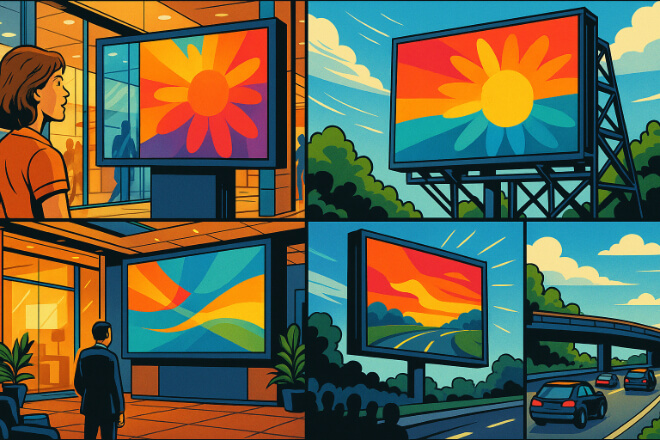
1) Typical Applications of Indoor LED Displays
Indoor LED displays are primarily used in indoor environments with close viewing distances, requiring detailed images, clear text, and high color fidelity. Typical applications include:
Used for promotional advertising, brand displays, and interactive experience screens, allowing customers to clearly see product information and promotional content even at close range.
- Corporate Lobbies:
Used for brand promotion, information display, or digital welcome screens, enhancing corporate image and leaving a lasting impression on visitors.
- 展览:
Displaying products or company information in exhibition halls or trade shows requires high-resolution screens to present exquisite images, allowing viewers to appreciate details even at close range.
In short, indoor LED displays prioritize high-quality image and visual experience, making them suitable for close-range viewing in environments with stable lighting.
2) Typical Applications of Outdoor LED Displays
Outdoor LED displays are primarily used for long-distance viewing and all-weather outdoor environments, requiring high brightness and strong protection.
Typical applications include:
广告牌: Installed on streets, squares, or highways, they need to be clearly visible even in sunlight during the day, while also being waterproof and dustproof.
运动的 Venues: Large-scale sports event displays for spectators to view match data, scores, and live video from a distance.
Traffic Signs: Highway or urban traffic signs requiring stable operation around the clock, displaying text, icons, and warning information to ensure driver safety.
In general, outdoor displays prioritize brightness, protection, and long-distance readability, making them suitable for outdoor, open, or large-area applications.
 English
  Español
  简体中文
简体中文  Français
  日本語
日本語  한국어
한국어  العربية