
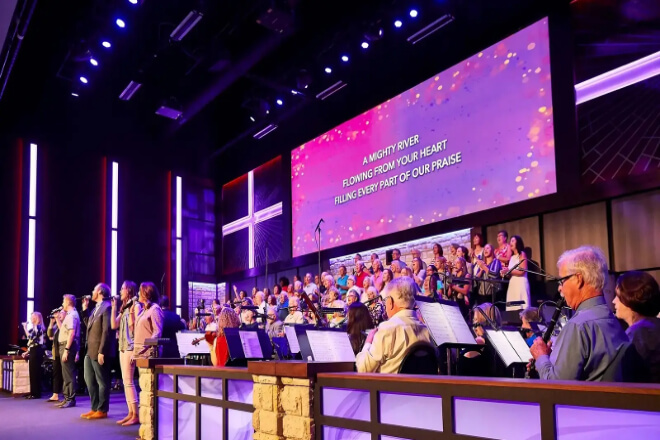
How Do LED Displays Improve Visibility in Large Churches?

介绍

很大 教堂, have you noticed that some congregants, due to their distance from the stage or poor viewing angles, cannot clearly see the sermon content or lyrics on the screen?

During the day, sunlight shining through stained-glass windows can also make projected images appear dim. While these problems may seem minor, they affect the continuity and engagement of the worship service.

So, how exactly do LED显示屏 improve visibility in large churches?

目录

1. The Core Value of LED Displays in Churches

In many modern churches, LED displays have become an indispensable part of the worship service. They not only enhance the interactivity of worship activities but also make information transmission more fluid and clear.

Below, let’s look at some of the core values of LED displays in churches.
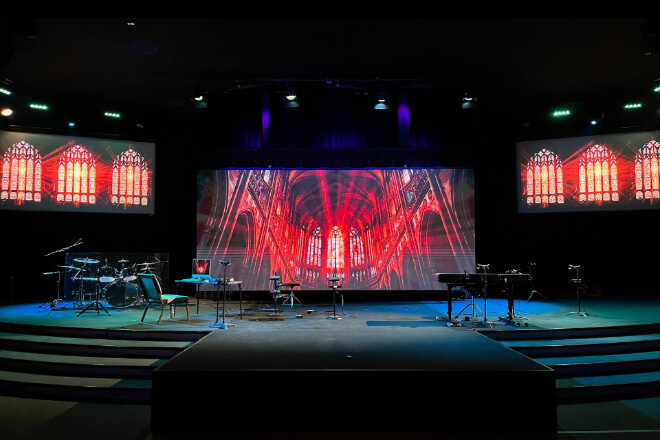
One of the most prominent advantages of LED displays is their high 亮度 and high contrast.

In many traditional churches, there may be large windows or strong lighting, making it difficult for ordinary displays to clearly present content.

The high brightness of LED screens ensures that even on bright sunny days, congregants sitting in the corners of the church can still see the information on the screen.

Whether displaying Bible verses or playing videos, the viewing experience will not be affected by lighting issues.

Churches often have spacious designs and dispersed seating arrangements. Therefore, a single display screen may not meet the needs of all viewers.

A major advantage of LED screens is that they can be spliced together according to the needs of the space, forming a large screen that covers the entire church’s field of vision.

For example, by splicing multiple small screens, it can be ensured that congregants from the front to the back rows can see the same content. This flexible design also makes the church’s space utilization more efficient.

Imagine that when prayer words, Bible verses, or lyrics are displayed on the screen, congregants don’t need to look down to find them in books; the text on the screen is clear enough for everyone to read and follow along.

The high-definition 解决 provided by LED displays not only makes the text clear and easy to read but also vividly presents images and videos.

Whether it’s static images or dynamic videos, worshippers can better understand and experience every message conveyed.

Modern churches, in addition to traditional sermons and hymns, are increasingly focusing on interaction and creating a more engaging atmosphere.

The use of LED displays not only makes information transmission more intuitive but also increases interactivity.

For example, the screen can display real-time prayer requests, show participants’ names, or allow everyone to sing along.

This sense of participation, especially the interaction presented through the large screen, makes the atmosphere of the entire church more vibrant and lively.

In short, the role of LED displays in churches goes far beyond a simple information display tool.

It not only allows the audience to easily see the content on the screen, improving the efficiency of information transmission.

But also enhances the immersive experience of the entire worship service through high-definition images and flexible design.

Churches of all sizes can benefit from LED displays, making every worship service more vibrant and modern.

2. Specific Ways LED Displays Improve Visibility in Churches

In churches, one of the most direct values of LED displays is that everyone can “see, see clearly, and keep up.” Whether sitting in the front, back, or side seats, the screen silently solves the visibility problem.
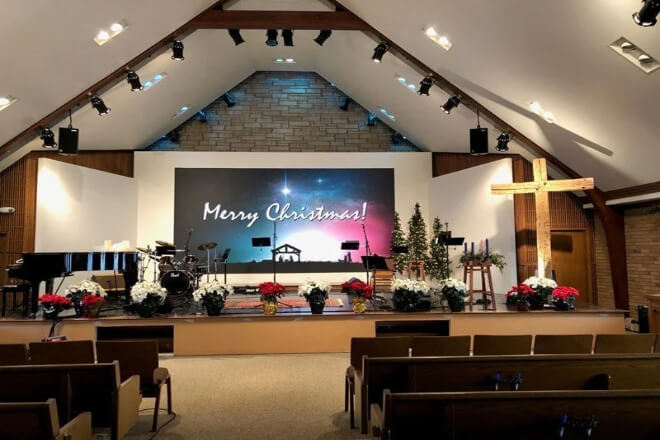
Many churches abroad have spacious spaces, and the seating arrangement is not entirely symmetrical.

Through the splicing and combination of multiple LED screens, full coverage can be achieved: the main screen displays sermon points, scriptures, or lyrics, while the side or rear screens cover areas where the view is easily obstructed.

This way, no matter which angle they are sitting at, people don’t need to frequently stretch their necks or turn their heads back and forth, and can naturally keep up with the rhythm of the service.

Natural daylight and 阶段 lighting are common scenes in churches. LED displays have good resistance to ambient light, and even when sunlight shines through stained glass windows, the screen content remains clearly visible.

At the same time, the image colors are uniform, the text edges are clear, not dazzling or blurry, and prolonged viewing does not easily cause visual fatigue, making it more friendly to the elderly and children.

During hymns, sermons, or video playback, lyrics, sermon notes, and visuals can be displayed simultaneously on every screen.

As the pastor switches content, all screens update instantly, avoiding the awkward situation where “some people have already turned the page, while others are still searching.”

This smooth synchronization experience makes the entire worship service more natural and rhythmic.

LED displays can also serve more thoughtful auxiliary roles, such as synchronized subtitles, sign language videos, and even simple voting or Q&A interactions.

This is very helpful for people with hearing impairments, new congregants, or younger generations.

The screen is no longer just a “display tool,” but an important bridge to help everyone better participate in worship and understand the message.

3. Key Considerations for LED Display Installation and Management

Installing and managing LED displays in a church is actually more nuanced than people might think.

Hanging the screen is only the first step; to make it truly effective, you need to consider location, brightness, content management, and daily maintenance.

If handled well, the screen can make the worship experience smooth and comfortable; if not, even a large screen may be difficult to see or distracting.

1). Screen Size, Position, and Angle

Screen size and installation angle directly affect the viewing experience of every congregant.

If the screen is too small or the angle is inappropriate, viewers in the back and side rows may not be able to see the content at all.

Generally, the main screen should be placed at the front of the stage or in the center of the pulpit, responsible for displaying scriptures, lyrics, and sermon points.

Side or rear screens can supplement blind spots, ensuring that congregants in every corner of the church can see clearly.

By combining the church space and seating layout, a reasonable design of screen position and angle can prevent people from having to look around and miss important information.

2). 亮度 and Grayscale Adjustment

Even if the screen is large, insufficient brightness or improper grayscale adjustment can make the image look hazy and the text blurry.

In a church, there may be sunlight shining through stained glass during the day and stage lighting at night.

Without proper brightness and grayscale adjustment, viewers may find the screen dim or glaring.

By finely adjusting brightness and grayscale, it can be ensured that text, images, and videos are clearly visible from any seat, with natural colors and comfortable visuals, preventing eye strain even after prolonged viewing.

3). Content Management System (CMS)

Modern LED screens are usually equipped with a Content Management System (CMS), which greatly simplifies operation.

Staff can use the CMS to synchronize multiple screens, switch content in real time, and even update screen information remotely.

This ensures that lyrics, scriptures, and images on the screen are instantly synchronized during hymns, sermons, or video playback, preventing discrepancies between screens and making the worship service more coherent.

4). Maintenance and Lifespan

Finally, the long-term stable operation of the screen is also crucial.

Regular cleaning of the screen, checking connections, and ensuring brightness uniformity can prevent uneven brightness or malfunctions that interrupt worship services.

Choosing high-quality screens and a reasonable maintenance plan can ensure that the LED display maintains high brightness, high clarity, and stable operation for many years, ensuring a smooth worship experience in the church.
5. Case Studies and Results

Case Study 1: Multi-screen Splicing in a Large Worship Hall

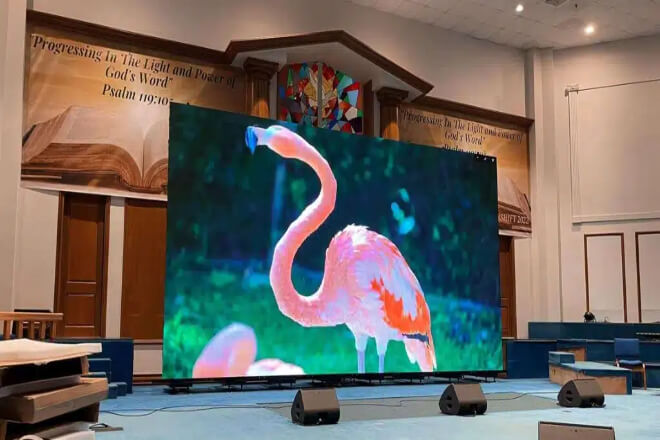
In a medium-sized American church, the seating extends over 40 meters from the front to the back, making it difficult for traditional projectors to ensure that parishioners in the back rows can clearly see scriptures and lyrics.

After introducing LED displays, the church installed a large screen in the center of the main stage, and added splicable secondary screens on both sides to cover blind spots.

The results showed that every parishioner, regardless of their seat, could easily see the text and video content.

The worship process was more coherent, participation in hymns and interactive sessions increased significantly, and audience feedback was more positive, with people feeling that “everyone could be involved.”

Case Study 2: Brightness Optimization in a Complex Lighting Environment

In a church with many windows, sunlight shines directly through the stained glass, resulting in poor projection quality and easily obscured text.

After installing LED displays, through brightness adjustment and grayscale optimization, the screen content remains clearly visible even in strong light.

Scriptures, lyrics, and even video images are not distorted due to lighting problems.

Significantly improving the audience’s viewing experience and reducing the need for the pastor to repeatedly prompt or wait for the audience to find passages in their books during sermons.

These cases demonstrate that screen layout solutions should be chosen based on the actual space, lighting conditions, seating arrangement, and activity requirements of the chapel.

Large spaces can utilize multi-screen splicing to cover the entire area; locations with complex lighting conditions require careful attention to brightness and grayscale adjustment.

And interactive worship services can benefit from multi-functional screens and a CMS (Content Management System).

A well-designed solution not only improves visibility but also enhances participation and the overall experience, ensuring that everyone in the chapel can truly “see and follow along.”

5. 结论

Through reasonable screen layout, brightness adjustment, and synchronized content management, the worship process becomes smoother and more natural.

For chapel managers, understanding the venue characteristics and planning an appropriate screen solution is key to maximizing the value of LED displays.

It not only makes things “visible” to everyone but also allows each worshipper to be more fully immersed in the service and experience its atmosphere.

最后, 请与我们联系 if you would like to learn more about LED displays.

发表回复

您的邮箱地址不会被公开。 必填项已用 * 注意

让我们现在开始我们的故事吧!

得到 2025 新价格 现在用于LED屏幕