
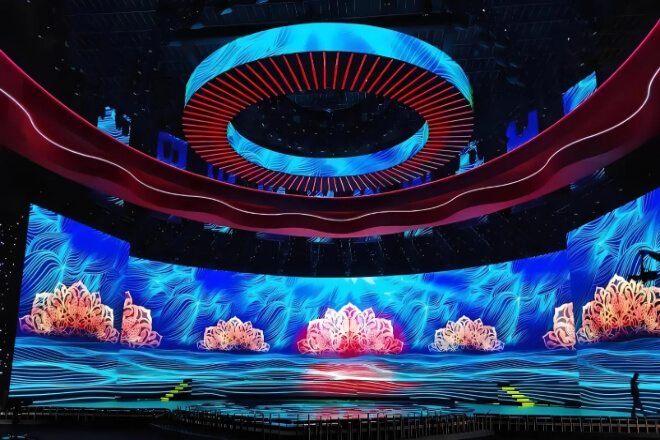
When creating an immersive stage, the placement of the LED屏幕 is actually more crucial than many people realize.
It’s not simply about placing a large screen at the back. You need to first consider how the entire space will be used: how large is the stage, where will the audience primarily sit.
And will they be viewing from the front, sides, or even around the 阶段? These factors directly influence the screen arrangement.
Generally, the main background screen is the core, used to display the main visuals, brand content, or important information.
Its position is typically in the center of the stage, allowing the audience to immediately grasp the key information.
Meanwhile, adding extended screens on the sides or above the stage prevents the image from being confined to the center, allowing it to expand outwards and create a more immersive feel.
For an even more “immersive” effect, the floor can be utilized with LED floor screens.
When the floor image and background are synchronized, the entire space feels connected. For example, the image extends from the wall to the audience’s feet.
Making it easier for them to become engaged, not just “watching a stage,” but feeling like they are in a scene.
Furthermore, modern LED screens are mostly modular, allowing for flexible splicing. This is very useful, enabling the creation of curved, cornered.
And even irregular shapes, making the stage more than a static flat surface, adding depth and variation.
Overall, the focus at this stage isn’t on the number of screens, but on how to “arrange” them correctly, allowing the space itself to tell a story.
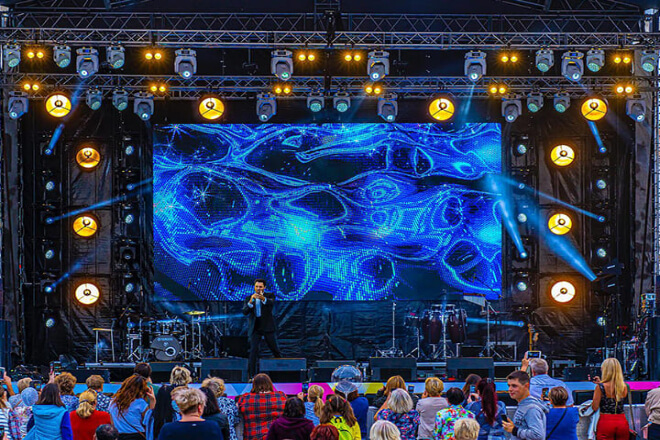
After the LED screens are set up, the most crucial element is actually “what to put on the screens,” which directly determines the audience’s experience.
Content creation must closely revolve around the event theme; otherwise, it’s like having a 阶段 but no soul.
Different types of events have different content directions: Concerts can incorporate visual effects and stage animations that interact with the music, creating a dynamic and exciting atmosphere.
Corporate events tend to focus on brand promotion and product demonstration animations, requiring clean, high-quality visuals that clearly convey the message.
For holiday-themed or large-scale events, virtual scene transitions, such as day to night or reality to fantasy, can be used to create an immersive experience.
Another easily overlooked point when creating content is considering screen size and resolution.
Using standard video may result in stretched or distorted images or unclear details, significantly diminishing the live experience.
Therefore, it’s crucial to confirm the screen ratio and 解决 before production to ensure a clear and vibrant image.
Additionally, LED屏幕 are bright and highly sensitive to color reproduction, so adjusting contrast and saturation appropriately can make the image brighter and more captivating on-site.
Overall, good dynamic visual content isn’t just about aesthetics; it’s about seamlessly integrating with the stage space, musical rhythm, and event theme to truly bring the screen to life and energize the entire audience.
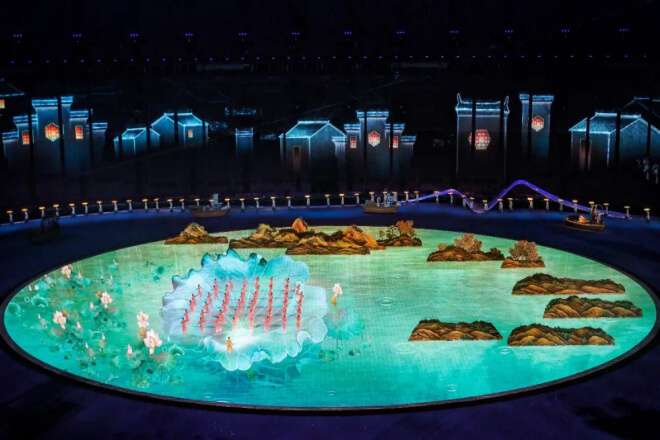
On stage, lighting and LED screens are a natural pair.
With only an LED screen, even the most dazzling visuals can appear thin and lack a sense of presence; with only lighting, while atmosphere can be created, visual impact is insufficient.
Linking them brings the entire stage to life, instantly enhancing the sense of space and rhythm.
This synchronization is typically achieved using control systems like DMX or Artnet, unifying lighting, screens, and even other 阶段 effects.
This allows their flashing, gradations, or scene transitions to occur synchronously, appearing as a unified whole rather than isolated elements.
This synchronization isn’t just about “lighting up simultaneously,” but about the lighting and screen visuals responding to each other.
For example, during the concert’s climax, the animation on the screen jumps rapidly to the music rhythm, and the lights flash and change accordingly.
Making the entire stage seem to surround the audience in light and shadow, creating an immersive experience.
Slow-paced visuals or atmospheric segments can be complemented by soft, gradient lighting, creating a soothing and comfortable space, making the entire stage feel like it’s breathing.
Through this design, the audience is no longer just “watching the stage,” but rather being moved by it, with visuals, rhythm, and atmosphere all blending together.
In short, the synergy between lighting and LED屏幕 transforms the stage from an ordinary large screen into a three-dimensional, rich, immersive space.
When the lighting, visuals, and rhythm are well-coordinated, the audience will be completely immersed in the experience, forgetting the world outside the stage and truly feeling the awe and charm it brings.
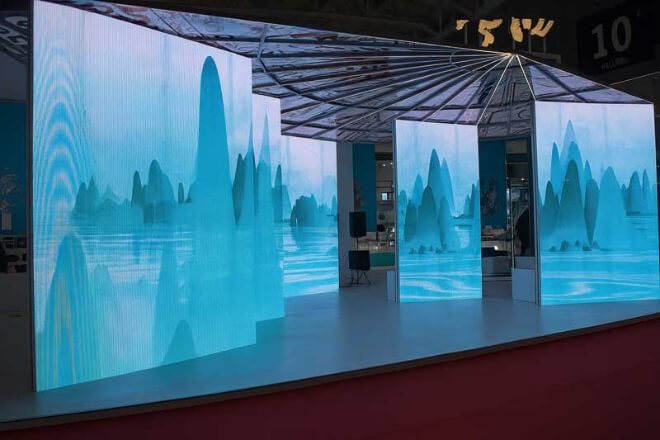
When you want the stage to truly “surround” the audience, creating an immersive experience, multi-screen integration and panoramic design are key.
Simply put, it’s not just about placing an LED屏幕 in the stage background.
The front, sides, top, and even the floor can be covered with screens, allowing the image to surround the entire space.
In this way, no matter what angle the audience stands from, they can see the complete visual effect, transforming the stage from a two-dimensional “enclosed 阶段.”
With this layout, scene transitions will also be more natural. For example, if the image extends from the front of the stage to the sides or the ground.
The audience will feel that the stage space is constantly changing and expanding, rather than a single screen displaying content.
Furthermore, adding panoramic animation, such as a scene extending from above to the audience’s feet.
Or simulating the dynamic changes of the sky, ocean, and virtual space, will create a strong sense of three-dimensionality and immersion.
However, a crucial point in multi-screen integration is that the signals must be synchronized and the stitching seamless.
Even with multiple screens, if there is any delay or gap in the image, the audience’s immersion will be instantly broken.
Therefore, during the design and construction process, the 解决, 刷新率, and stitching method of each screen must be pre-tested to ensure the image flows smoothly and continuously as a whole.
Only by achieving this can multi-screen integration and panoramic animation truly unleash their magic, transforming the stage into an immersive space where boundaries are forgotten.
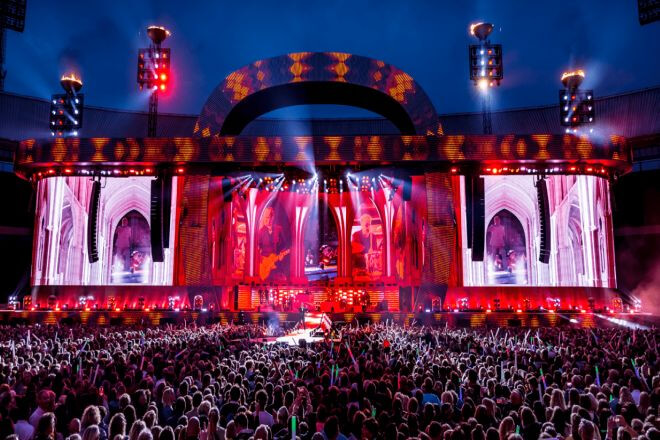
No matter how cool the stage design or how exciting the LED content, if the technology isn’t up to par, the entire effect may be compromised.
Therefore, pre-event technical support and on-site testing are absolutely essential.
This step primarily involves checking the LED screen’s performance indicators: sufficient 亮度, smooth refresh rate.
和 解决 matching the content to ensure the image is clear and vibrant on the large screen, without flickering, pixelation, or lag.
Simultaneously, a comprehensive test of the control system, signal transmission lines, and 阶段 equipment linkage is conducted to ensure the screen, lighting, sound.
And other special effects equipment operate synchronously, guaranteeing smooth and natural scene transitions.
To prevent unforeseen circumstances, backup plans and safety measures must be prepared in advance.
For example, critical equipment must have backup power supplies, and emergency plans must be in place to quickly activate in case of malfunctions in important signal lines or control systems.
These preparations, though seemingly insignificant, are crucial on-site, preventing awkward or chaotic situations during the event.
Furthermore, this step requires close teamwork. LED, lighting, sound, and stage operators need constant communication to confirm every detail.
Ensuring every visual, lighting change, and musical piece is presented as planned.
Only in this way can the meticulously arranged stage, the immersive multi-screen design, and the dynamic visual content truly function effectively.
With robust technical support, the stage can operate smoothly, allowing the audience to be fully immersed in the event’s atmosphere and enjoy a seamless and stunning visual experience.
 English
  Español
  简体中文
简体中文  Français
  日本語
日本語  한국어
한국어  العربية