
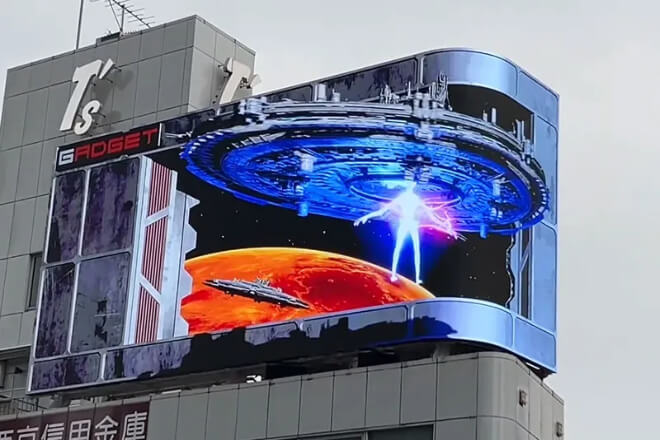
With the advancement of technology, LED displays are no longer just simple image display tools.
In particular, 3D LED 显示屏 and curved LED displays are bringing a whole new immersive experience to 阶段, 展览, commercial events, and even art installations.
3D LED displays use parallax imaging or naked-eye 3D technology to give images a realistic sense of depth.
Viewers don’t need to wear 3D glasses to feel the spatial effect of the images “jumping out” of the screen.
For example, at a brand launch event, a 3D LED screen can make products appear to float in the air, with clear details, which not only impresses the audience but also increases interactivity and participation.
Curved LED displays, relying on flexible LED modules, can achieve arc, ring, and even more complex irregular shapes.
For example, on a large concert stage, a circular curved screen can surround the stage, working in conjunction with lighting and stage design to create a 360-degree immersive visual experience.
Or, in exhibitions, curved LED screens can be used as curved booth backdrops, ensuring a seamless viewing experience from any angle.
The advantages of these two types of displays extend beyond visual impact; they also offer more flexible design options and a strong sense of technology.
They allow for more coherent and vivid content presentation and can be tailored to various creative formats to meet the needs of different events.
Whether it’s a stage backdrop, exhibition display, brand launch, commercial event, or art installation, 3D and curved LED displays can become eye-catching highlights.
Simply put, 3D and curved LED displays are not just screens, but a completely new visual language.
Choosing them not only enhances the audience’s immersion and interactive experience but also imbues events with a technological and modern feel, leaving a lasting impression.
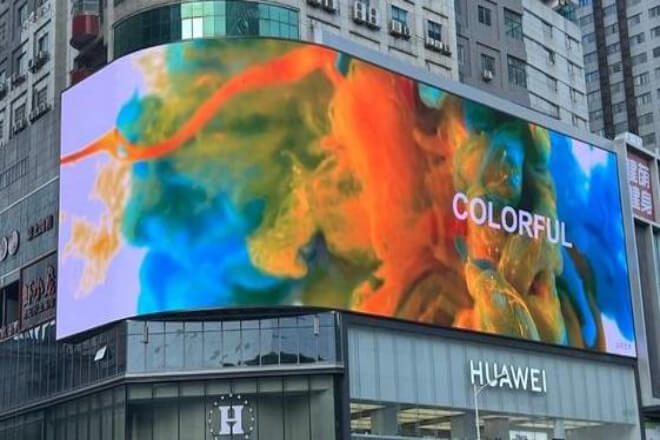
In modern events, simple flat screens are no longer sufficient to satisfy audiences’ demands for immersion and creativity.
3D and curved LED displays were created precisely for this purpose. They not only make the visuals more stunning but also add more possibilities to the event.
1) Creating an Immersive Visual Experience
3D and curved screens make the audience feel as if they are inside the scene. Whether it’s stage effects at a concert or product displays at a brand launch.
The audience can feel the three-dimensionality and immersiveness of the image, creating a truly “present” experience.
For example, at a car launch, a 3D LED screen can make the new car appear to drive out of the screen, allowing the audience to more intuitively experience the design details.
2) Enhancing Brand Communication
Stunning visual effects leave a lasting impression on the audience.
Through 3D stereoscopic images or curved surround screens, brand elements can be presented in a more vivid and unique way, enhancing brand memorability.
For example, in a new product launch event, the brand logo and key selling points are presented through 3D animation rotating on a curved screen, making them easier for the audience to remember than traditional flat displays.
3) Breaking Traditional Stage Boundaries
Curved screens and 3D screens can break through the limitations of flat stages, achieving visual extension and spatial integration.
The stage is no longer limited to a rectangular background; the image can extend to the sides, top, or even surround the entire stage, making the visual effect more coherent.
In large concerts, curved LED screens are often used to surround the stage, creating a 360-degree visual experience.
4) Enabling Interactive Marketing
Combined with motion capture, AR effects, and other technologies, 3D and curved LED screens allow the audience to participate in the event.
The audience’s movements, expressions, and even positions can trigger screen effects, enhancing engagement and interactivity.
For example, in the interactive experience area of an exhibition, viewers can simply wave their hands or move around to see the animation on the screen change accordingly, enhancing the fun and appeal of the event.
5) Adding Storytelling to Event Content
3D and curved LED screens are not only display tools but also media for storytelling.
By combining visuals with emotion, it can create a “visual narrative,” making the event content more vivid and coherent.
For example, in a charity gala, curved LED screens can display images and scenes of beneficiaries’ stories, resonating with the audience both visually and emotionally.
In general, 3D and curved LED displays not only make events more impactful but also enhance brand value, improve interactive experiences, overcome spatial limitations.
And provide storytelling possibilities. They are becoming indispensable visual tools in modern events.
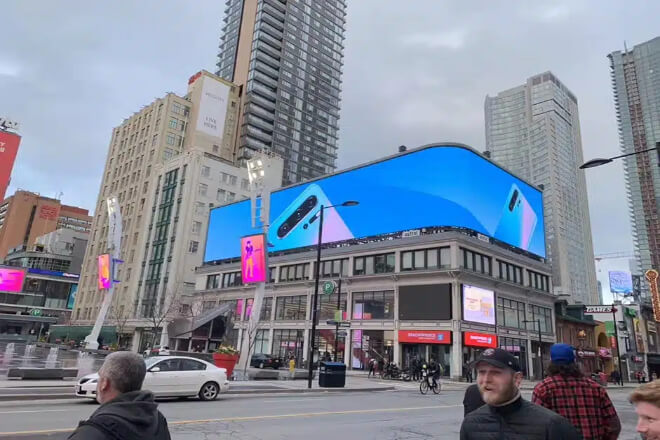
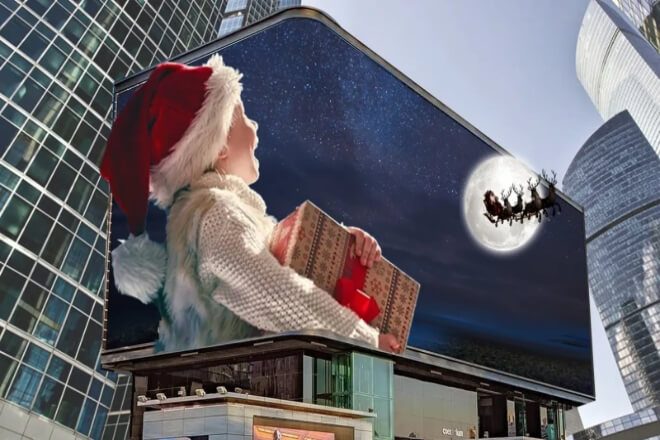
Many people think choosing LEDs is as simple as: “What’s your budget? I’ll give you the clearest one!”
But in reality, a truly suitable LED solution for an event is often a combination of content, venue, style, and hardware.
The following points are things many planners have only gradually learned after making mistakes.
1) First, clarify two things: How big is the venue? How far away is the audience?
This is the “starting point” for LED selection.
如果 观看距离 is short (for example, the audience is just a few rows in front of the stage), you must choose LEDs with a smaller pitch; otherwise, the words on the stage will look like mosaics.
For viewing distances of a considerable distance (e.g., large press conferences, outdoor events), the resolution can be appropriately reduced; the larger the screen, the more impressive it will be.
In short, the closer the screen, the more detailed it needs to be; the farther away, the more grand it needs to be.
2) The event theme determines whether you need advanced effects like “3D” and “curved surfaces.”
Don’t show off technology for the sake of showing off; consider whether it suits the event’s style.
Technology, automotive, new product launches → 3D, curved screens, and immersive experiences are all pluses; the audience’s “wow” is well worth the price of admission.
Award ceremonies, forums, government events → Flat LEDs are more stable and visually appealing, conveying a stronger sense of formality and avoiding overly flashy content.
Youthful brand events, trendy pop-ups → For those who want to take photos and create compelling content, curved screens and 3D content easily become social media material.
Therefore, you can ask yourself:
“Is the visual focus of this event stable? Beautiful? Or explosive?”
3) Don’t forget venue structure and safety.
This is something only those who have truly learned from experience understand.
Some 酒店 stage ceilings have low load-bearing capacity, making it impossible to suspend a large screen.
Some venues have insufficient power, causing the circuit breaker to trip when the LEDs are only half-lit.
In some locations, the backdrop wall cannot be drilled, requiring a floor-mounted support system.
Therefore, it is crucial to communicate with the venue in advance regarding: load-bearing capacity, power supply, suspension points, and wiring.
If any one of these issues cannot be resolved, the entire plan must be redone.
4) Content Production and Hardware Matching
Many people believe that 3D effects are achieved solely through LED 解决.
This is not entirely accurate. Truly stunning 3D effects are the result of a harmonious combination of content, modeling, rendering, and perspective.
If:
The screen is expensive, but the content is just ordinary flat video → The effect is worthless.
The budget is limited, but the content team is strong → A truly “explosive” effect can still be achieved.
Therefore, professional planners understand this saying:
“The value of 3D LED is 70% in the content and 30% in the screen.”
5). The on-site technical team must be reliable (this is really important).
Everyone who has organized an event has experienced this: Everything went smoothly during rehearsal.
But suddenly the screen went black for three seconds at the start, and everyone missed a beat.
When you choose LEDs, you are actually choosing a service:
Is the on-site engineering team experienced enough?
Are backup equipment, backup power, and backup wiring prepared?
Is the debugging efficiency high?
Are the delay, 亮度, and contrast calculations accurate?
A good technical team can give you peace of mind from the beginning to the end of the event.
A poor team will keep you in a constant state of tension, as if “something might happen at any moment.”
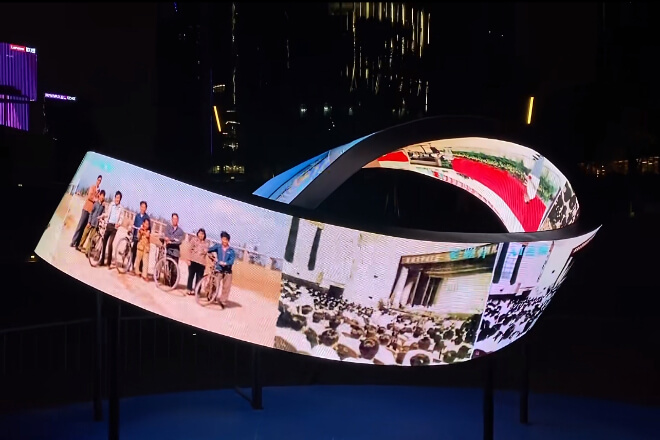
In modern event planning, 3D and curved LED displays are no longer just “large screens on stage”; they are high-value investments that can bring real commercial returns.
Whether it’s a corporate launch, concert, exhibition, or urban cultural tourism project, these screens can help brands gain a competitive edge in terms of visual appeal and experience.
1) Creating Differentiated Competitiveness for Brand Events
In a highly homogenized event market, simple flat screens and traditional stage design are unlikely to leave a lasting impression on the audience.
3D and curved LEDs, through stereoscopic images, surround designs, and innovative shapes, provide a clear differentiation for brand events.
For example, using naked-eye 3D to showcase a new product at a technology launch event allows the audience to directly see the product’s internal structure.
And functional highlights, instantly making the event more technologically advanced and professional than competitors.
2) Attracting More Media and Audience Attention
High-tech LED screens naturally possess the ability to “attract attention.”
Stunning visual effects not only attract on-site audiences but also become hot topics for media reports and social media dissemination.
In large-scale concerts or flash mob events, curved LED screens surrounding the stage, combined with 3D animation.
Easily become the focus of photos, short videos, and live streams, bringing additional exposure and brand promotion value.
3) Enhancing the event’s prestige and customer satisfaction
High-quality visual experiences directly elevate the event’s perceived prestige, allowing participants to perceive the brand’s dedication and strength.
For example, at high-end brand product launches or VIP events, wraparound curved LED screens and 3D dynamic visuals not only create a stunning stage effect.
But also enhance audience immersion and participation, thereby increasing customer satisfaction and event reputation.
4) Achieving multiple uses and reducing long-term promotional costs
Although the initial investment in 3D and curved LED screens is high, the screens themselves can be reused repeatedly in different types of events.
The same screen can be reused for launches, exhibitions, city events, galas, or flash mobs.
Compared to one-time stage setups or prop production, this saves significant costs in the long run while improving resource utilization efficiency.
5) Aligning with the future trend of digital and experiential events
The event industry is rapidly developing towards digitalization, immersion, and interactivity.
Investing in 3D and curved LED screens not only meets the high-quality demands of current events but also lays the foundation for creating reusable, interactive, and online-shareable digital event experiences in the future.
As audiences demand increasingly sophisticated visual experiences, these screens can also help brands stay ahead of the curve and establish an image of innovation and technology.
 English
  Español
  简体中文
简体中文  Français
  日本語
日本語  한국어
한국어  العربية