
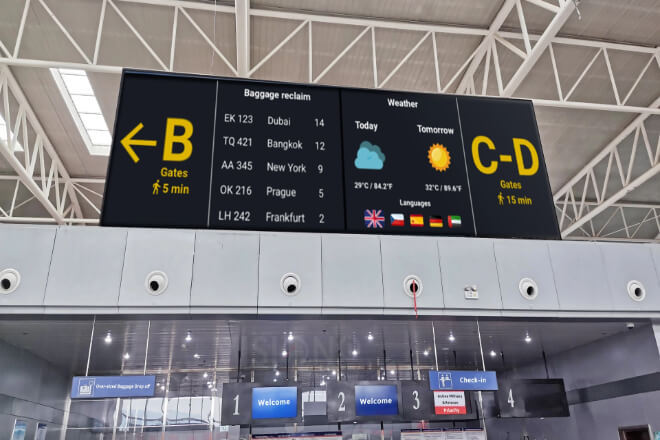
When undertaking an airport عرض الصمام project, the first step is crucial—understanding exactly what the screen is used for.
It sounds simple, but if this step isn’t clear, many subsequent configurations and designs will go astray.
For example, if the screen is used to display flight information, the focus is on “clarity” and “accuracy.”
Passengers need to see key information, such as flight times and boarding gates, at a glance, so the requirements for resolution, font clarity, and refresh stability are relatively high, with no lag or blurriness.
For information screens in waiting areas, besides basic information display, they may also need scrolling content, announcements, and even service information.
In this case, screen size and زاوية الرؤية become more important to ensure everyone in different positions can see clearly.
Another example is gate guidance screens or information screens. These are more focused on “guidance,” and their locations are usually fixed.
They require concise and intuitive information, moderate سطوع—not glaring but clear—to help passengers quickly determine their direction.
However, advertising screens have a completely different approach. The focus is on visual effects, such as higher brightness, more vibrant colors, larger size, and even dynamic content to attract attention and encourage people to look at them more.
Simply put, different uses determine the “personality” of the screen. Whether it prioritizes practical information or visual appeal, the needs are completely different.
Understanding this will prevent you from making wrong choices regarding size, clarity, and brightness.
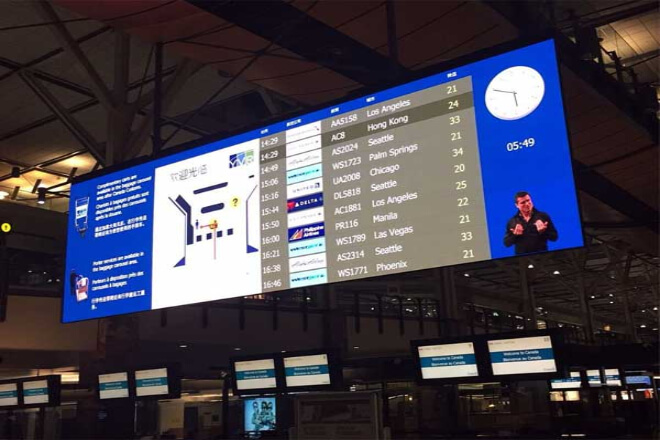
In places like airports, the usability of a screen boils down to one thing: can it be seen clearly from a distance?
Because of the large crowds, spacious areas, and long distances, even the largest screen is useless if the image quality is inadequate.
First and foremost, the text must be large and clear enough. Many passengers read as they walk, even glancing at it from a distance.
If the font is too small or unclear, key information, such as boarding gate or flight times, can easily be missed.
Therefore, when designing content, “easy to read at a glance” is more important than “a lot of information.”
Secondly, the image must not be blurry, which is related to مساحة وحدة الصورة. An inappropriate pixel pitch might look okay from a distance.
But at medium distances, it can easily appear grainy, affecting overall clarity. Especially in airports where people are constantly moving, image detail must keep up.
Color is also crucial. Brighter isn’t always better; it should be “comfortable to look at.” If the colors are too glaring, prolonged viewing will be uncomfortable and negatively impact the experience.
Especially in waiting areas where people spend a lot of time, a soft yet clear image is more suitable.
Another easily overlooked point is that the image must not flicker when moving, which is related to the refresh rate.
إذا معدل التحديث isn’t high enough, the screen may flicker when displaying dynamic content, and even show noticeable stripes when photographed with a mobile phone.
This significantly impacts the viewing experience in a high-frequency usage environment like an airport.
Simply put, the image quality of airport LED screens isn’t just about “displaying” information; it’s about being clearly and comfortably viewed from various distances and angles.
This may seem basic, but it’s crucial and directly affects the user experience.
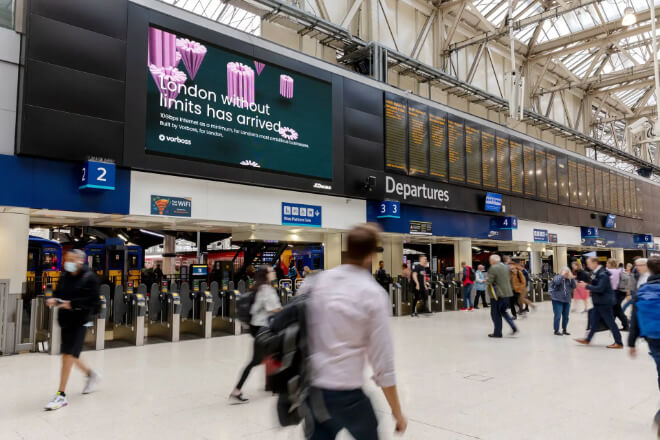
One characteristic of airports is their complex lighting. Many areas have large glass curtain walls, resulting in very strong direct sunlight during the day.
If the screen سطوع is insufficient, it can easily be “smothered,” appearing grayish or even unreadable.
Therefore, LED screens must have sufficient brightness to remain clearly visible during the day.
Imagine a passenger standing in a brightly lit area looking at a dimly lit screen; they might have to squint to find information, which is a very poor experience.
Especially for critical information like flight information and boarding announcements, unclear visibility can easily affect travel efficiency.
Therefore, “sunlight resistance” is a fundamental requirement for airport screens.
However, higher brightness isn’t always better. At night or in dimly lit areas, maintaining a consistently high brightness on the screen can be glaring and even uncomfortable.
This is especially true in waiting areas like airport lounges, where passengers spend a significant amount of time; an overly bright screen can negatively impact the overall experience.
Therefore, the more common approach now is automatic brightness adjustment.
Based on changes in ambient light, the brightness is automatically increased during the day and decreased at night.
This ensures clear visibility during the day while avoiding glare at night, and it also saves energy.
Simply put, airport LED screens need to be “smart” in their brightness: bright when necessary and soft when appropriate. This not only improves visibility but also enhances the overall comfort.
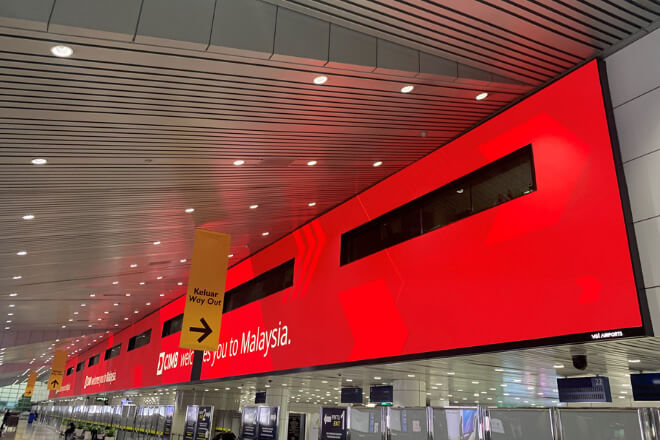
المطارات have a very real characteristic—they operate virtually 24/7. This means that LED displays must also be “on duty around the clock” and cannot afford to malfunction.
If the screen suddenly goes black or displays abnormal information, the impact goes beyond just visual unpleasantness.
It could even cause passengers to lose their gates or miss their flights, leading to serious problems.
Therefore, stability is a “bottom-line requirement” in airport projects, arguably even more important than image quality.
No matter how good the visuals are, if the screen is unstable at crucial moments, all the previous work will be wasted.
To ensure this, many projects incorporate “backup designs.” For example, power, signal, or control systems may have dual backups.
If one line fails, the other can immediately take over, preventing the screen from going completely black.
There are also module-level redundancy designs, ensuring that even if a small component fails, the entire screen will remain operational.
You can think of this as a “just in case” mechanism—it might not be noticeable under normal circumstances, but it can step in during critical moments.
After all, in an airport setting, the margin for error is very small; you can’t wait until problems occur to address them.
Simply put, airport LED screens need to be more than just aesthetically pleasing; they need to be reliable.
Stable operation, uninterrupted service, and no blackouts are its most basic and crucial capabilities.
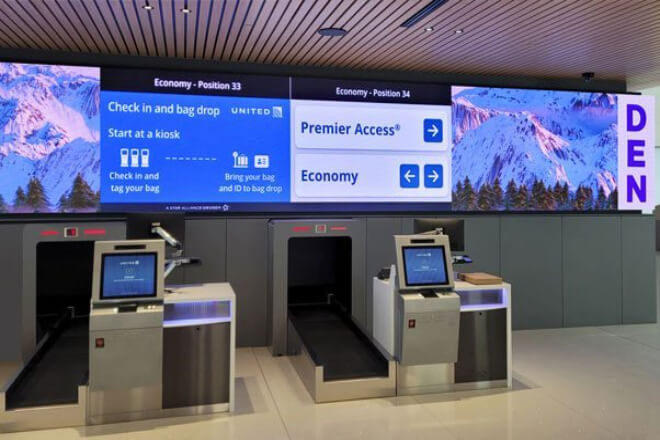
In airport settings, a particularly critical but easily overlooked point is whether the information is updated in real time.
Flight information is constantly changing—delays, gate adjustments, and boarding time changes are common.
If the screen isn’t updated promptly, passengers can easily misread information or go to the wrong place.
For example, if a boarding gate suddenly changes, passengers might go to the wrong gate if the screen still displays the old information.
Similarly, if a flight is delayed and not displayed promptly, passengers might be stuck waiting.
In such cases, the problem isn’t just a poor experience, but a direct impact on travel efficiency.
لذلك، يعرض الصمام not only need to display content, but more importantly, they need to update that content quickly and accurately.
This typically requires interfacing with the airport’s flight system to synchronize data, ensuring that the front-end screen updates immediately upon changes in backend information.
Another crucial point is “low latency.” Even a delay of just a few seconds can cause confusion in high-frequency changing scenarios.
Especially during peak hours, with large crowds and rapidly changing information, timely updates become even more critical.
Simply put, in airports, screens are not just “display tools,” but rather information windows.
Only by achieving real-time updates and zero latency can they truly help passengers, rather than causing them inconvenience.
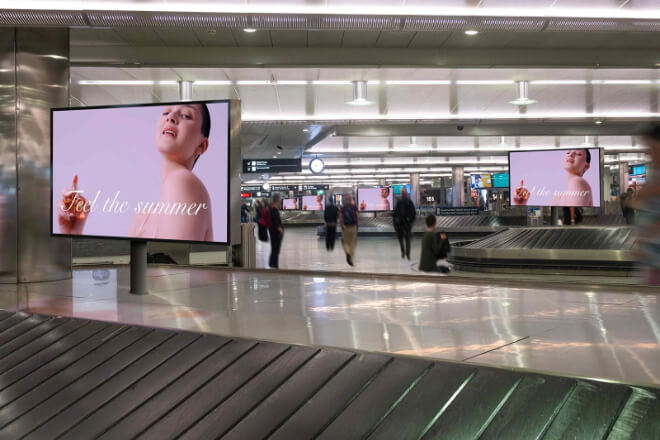
In airport projects, “where and how to install” LED displays is a critical question.
The installation method not only affects the final visual effect but also directly relates to safety and even future maintenance and stability.
For example, whether it’s wall-mounted, ceiling-suspended, or floor-standing, different installation methods place different demands on the screen’s size, weight, and structure.
Wall-mounted installations offer greater stability and are suitable for information display; ceiling-suspended installations save space and create a more floating visual effect.
While floor-standing screens are more flexible and suitable for high-traffic areas or temporary information displays. Different locations also have different uses.
Airports have extremely high passenger traffic, which places even higher demands on installation.
The screen must be securely fixed, and the structure must be fully designed and reinforced to prevent any loosening or wobbling.
After all, structural problems not only affect usability but can also pose safety hazards, which cannot be ignored.
Furthermore, the installation location also affects viewing quality.
For example, an unsuitable height may result in poor visibility for some, and an incorrect angle may cause glare or a poor viewing angle.
Therefore, the design should not only consider “how well it can be installed” but also “how well it works in this location.”
In short, the installation method is not just a construction issue but also a comprehensive design issue.
Choosing the right location, ensuring a sound structure, and guaranteeing safety are all essential for a screen that is both aesthetically pleasing and reliable.
 English
  Español
  简体中文
简体中文  Français
  日本語
日本語  한국어
한국어  العربية