
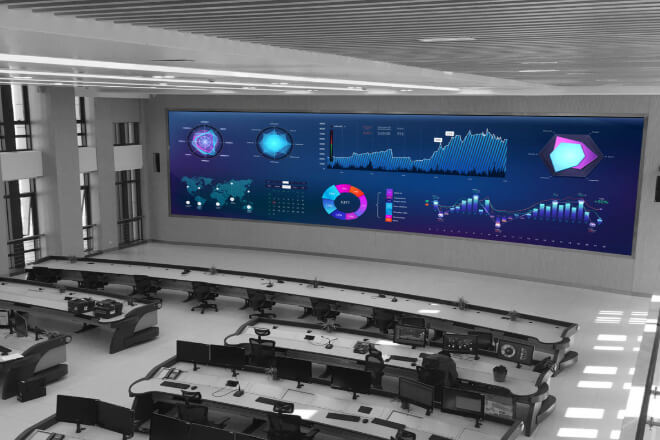
As the “big eyes” that staff watch every day, it can display various monitoring screens, business data, and command information in real time, with clear images and rapid response.
For example, in a traffic control center, you can simultaneously see real-time traffic conditions at various intersections, traffic light status, and congestion analysis data. Even in the event of sudden congestion, it can be detected and dispatched immediately.
LED displays have high دقة and large screens, so even when multiple videos and charts are displayed simultaneously, details remain clear.
For example, in a power dispatch center, a large screen can simultaneously display the current, voltage, and load status of different substations, as well as the line status marked on a map. Even complex data is readily apparent.
Furthermore, the seamless integration of the screens provides excellent visual coherence, with smooth, unobtrusive images that don’t disrupt staff focus.
Light adaptability is another strength. In a conference room under direct sunlight during the day, the screen remains clear; during night shifts, the brightness can be lowered to avoid glare and eye strain during extended viewing.
For instance, in a security control center, multiple camera feeds are displayed during nighttime patrols.
Even in low light, the images remain clear, allowing for the rapid identification of key and suspicious individuals.
LED screens also display dynamic images smoothly. High refresh rates and low latency mean that video monitoring and real-time data changes are presented almost synchronously, without stuttering or ghosting.
For example, in an emergency command center, drone footage from an accident site can be displayed in real-time on a large screen.
Commanders see the footage almost simultaneously with the scene, facilitating rapid decision-making.
Finally, LED displays support multi-screen partitioning and flexible layouts. A large screen can simultaneously display surveillance video, data reports, and situation maps, and layout adjustments are readily available.
In a smart city control center, data from multiple systems, including traffic, sanitation, emergency response, and energy, can be viewed simultaneously.
Staff can quickly switch between focusing on key areas, making information centralized and intuitive, and improving efficiency in daily management and emergency response.
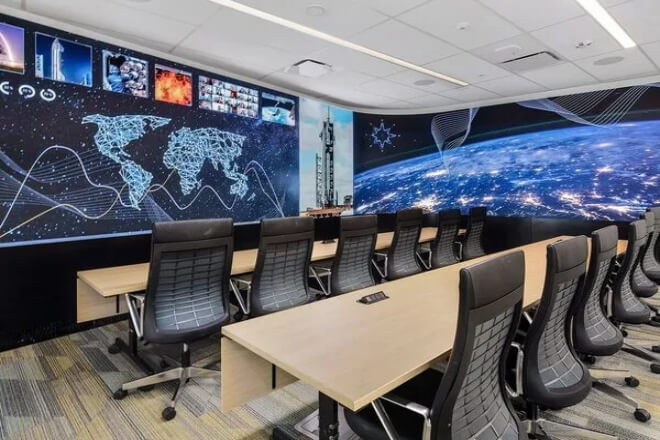
Besides clear visuals and real-time information, LED displays also demonstrate excellent reliability and stability.
Control centers operate 24/7, requiring screens to remain almost constantly operational; therefore, the ability to work continuously for extended periods is crucial.
For example, in a power dispatch center, screens display data and alarms from various substations 24 hours a day.
Even after months of continuous operation, flickering or brightness degradation are rare, giving dispatchers peace of mind.
In terms of hardware design, LED screens are designed for anti-aging, heat dissipation, and vibration resistance.
Internal heat dissipation modules and high-quality LED displays reduce the impact of temperature.
And the vibration-resistant design ensures stable operation even under slight vibrations or in high-rise computer rooms.
In a traffic control center, this means the screen will not be affected by floor vibrations or traffic interference.
Furthermore, LED displays typically feature redundant systems and rapid switching capabilities.
If a module fails, the system can immediately switch to a backup unit, ensuring virtually uninterrupted display.
For example, in an emergency command center, if a control board malfunctions, the system automatically switches to a backup unit, with staff barely noticing any interruption.
In terms of maintenance, front and rear maintenance modes offer greater flexibility. When space allows, maintenance can be performed from the front.
When space is limited, or the screen is suspended high, it can be operated from the rear, providing convenience without affecting screen operation.
Overall, these designs ensure long-term stable operation of the LED screen, making it ideal for 24/7 control center environments.
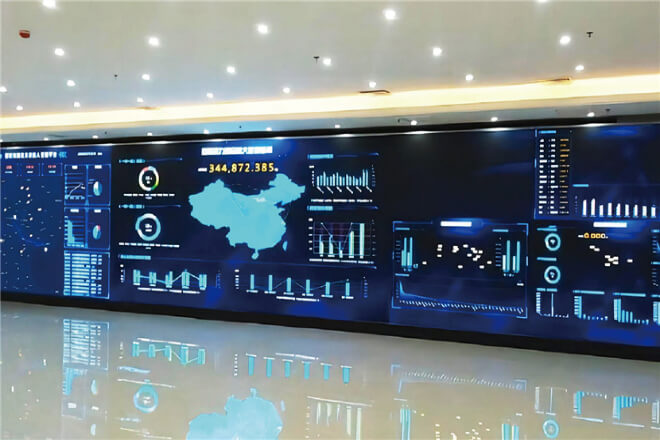
In the control center, the LED display acts as the staff’s “eyes,” displaying various monitoring images, business data, and command information in real time, providing a comprehensive overview.
For example, in a traffic command center, a large screen can simultaneously display real-time traffic conditions, traffic light status, and congestion analysis data for various intersections. In the event of sudden congestion, staff can detect and respond immediately.
LED displays boast high دقة and large screens, maintaining clear detail even when displaying multiple videos and complex charts simultaneously.
In power dispatch centers, a single screen can simultaneously display current, voltage, load information, and line maps from multiple substations.
The images are seamless, without noticeable seams, making them more intuitive and facilitating quick situation assessment for staff.
The screen’s high سطوع and contrast ensure clear visibility both day and night, making key alarms and data easily identifiable, and reducing eye strain even after prolonged use.
Besides excellent display quality, LED screens also offer outstanding stability. Control centers operate 24/7, requiring screens to remain almost constantly operational.
For example, in power dispatch centers, screens display data and alarms from various stations 24 hours a day, showing minimal flickering or brightness degradation even after months of continuous operation.
The screens also feature internal heat dissipation and shock-resistant designs, ensuring stable operation even in high-temperature environments or during building vibrations.
Furthermore, most LED screens are equipped with redundant systems. If a module fails, the system quickly switches to a backup unit, ensuring almost uninterrupted display and eliminating concerns about information loss for staff.
In terms of integration and information management, LED screens also excel. They are compatible with monitoring, dispatching, and command systems, displaying data from different sources on a single large screen.
In a smart city control center, traffic monitoring, sanitation management, and emergency dispatch system feeds can be displayed simultaneously, allowing staff to grasp the overall picture without frequently switching interfaces.
The screens can also collect data in real time and dynamically display changes. For example, abnormal current or voltage at a substation will immediately highlight, allowing dispatchers to identify problems immediately.
Simultaneously, through visualization analysis functions, traffic flow, energy consumption, or alarm status can be intuitively presented using heatmaps and trend curves, aiding in rapid judgment and decision-making.
The central control platform can uniformly manage the display content of all screens. Whether switching screens, adjusting layouts, or adding data sources, all operations can be centralized, making maintenance more convenient.
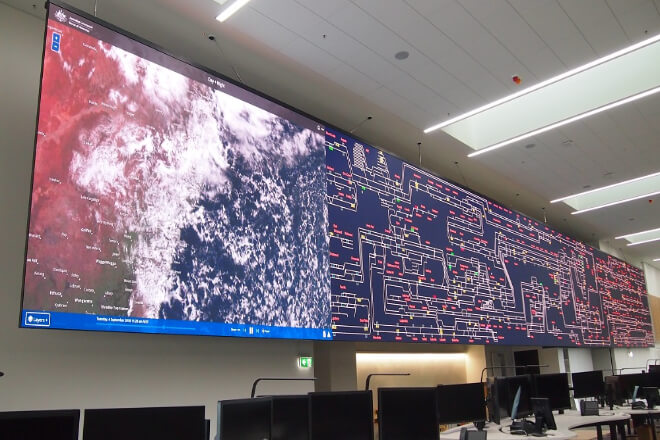
In the control center, LED displays act like “big eyes” for staff, displaying monitoring images, business data, and command information in real time, allowing for a comprehensive overview at a glance.
For example, in a traffic control center, a large screen can simultaneously display traffic conditions, traffic lights, and congestion data at various intersections, allowing for immediate detection and dispatching of emergency responses.
The screen’s high دقة and large size ensure clear detail even when displaying multiple video feeds and complex charts simultaneously.
In a power dispatch center, data from multiple substations and power line maps can be presented simultaneously.
With seamless, continuous visuals that reduce eye strain even after prolonged viewing. High brightness and contrast ensure clear visibility of key alarms day and night.
In terms of stability, LED screens operate reliably around the clock. Even after several months of continuous 24-hour use, flickering or brightness degradation is rare.
The heat dissipation and shock-resistant design allow the screen to operate stably even in high temperatures or during building vibrations.
With a redundant system, if one module fails, the system can quickly switch to a backup unit, ensuring a virtually uninterrupted display.
LED screens also excel in integration and information management. They are compatible with monitoring, dispatching, and command systems, centrally displaying data from different sources.
For example, traffic, sanitation, and emergency display screens in a smart city control center can be presented simultaneously.
With real-time data collection and dynamic display, highlighting anomalies, and supporting visual analysis and rapid decision-making.
The central control platform manages screen content uniformly, making layout adjustments or adding data sources convenient and efficient.
In terms of operation and maintenance, LED screens are also worry-free. Remote monitoring and diagnostics reduce manual inspections.
Modular design allows for quick replacement or upgrades, low daily maintenance costs, and critical systems will not be interrupted due to screen failures.
For example, in an emergency command center, even if a screen is temporarily out of service, the backend can quickly switch to a backup unit, allowing command operations to continue as normal.
 English
  Español
  简体中文
简体中文  Français
  日本語
日本語  한국어
한국어  العربية